Advances in Engineering Advances in Engineering features breaking research judged by Advances in Engineering advisory team to be of key importance in the Engineering field. Papers are selected from over 10,000 published each week from most peer reviewed journals.

J. Chem. Inf. Model., 2013, 53 (3), pp 584–591.
Hiroshi Izumi, Akihiro, Wakisaka, Laurence A. Nafie, Rina K. Dukor.
National Institute of Advanced Industrial Science and Technology (AIST), AIST Tsukuba West, 16-1 Onogawa, Tsukuba, Ibaraki 305-8569, Japan and
Department of Chemistry, Syracuse University, Syracuse, New York 13244-4100, United States and
BioTools, Inc., 17546 SR 710 (Bee Line Hwy) Jupiter, Florida 33458, United States.
Abstract
It is shown that fuzzy search and data mining techniques of supersecondary structure homology for subunits of proteins using conformational code patterns of {Alpha}-helix-type (3{Beta}5{Alpha}4{Beta}) and {Beta}-sheet-type (6{Alpha}4{Beta}4{Beta}) fragments can be used to extract correlations between fragments of MHC class I molecules and the light chain of immunoglobulins. The new method of conformational pattern analysis with fuzzy search of structural code homology reflects well the shape of main chain rather than secondary structure in comparison with the DSSP method. Further, the data mining technique using the combination of h- and s-fragment patterns can quantify the supersecondary structure homology between any subunits of proteins with different amino acid sequences. Characteristic fragment patterns (string “shhshss”), which were sandwiched between two identical amino acid sequences His and Pro, were found in light chains of various types of immunogloblins, {Alpha}-chain and {Beta}-2 microglobulin of MHC class I and {Alpha}-chain and {Beta}-chain of MHC class II, but not in heavy chains of Fab immunoglobulin fragments and T cell receptors (TCR). Leukocyte immunoglobulin-like receptors (LILR) are related by the conformational fragment (string “shhshss”) to {Beta}-2 microglobulins as a type of pair forms (string “sohsss”). Further, human IgM rheumatoid factor, one of the immunogloblins, did not strongly exhibit the conformational fragment pattern. Nonclassic MHC class I molecules CD1D, MIC-A, and MIC-B, which have functions to activate NKT, NK, and T cells, did not also clearly show the patterns. These code-driven mining techniques can be utilized as a metadata-generating tool for systems biology to elucidate the biological function of such conformational fragments of MHC I and II molecules, which come in contact with various signal ligands on the surface of T cells and natural killer cells.
Copyright © 2013 American Chemical Society
Additional information
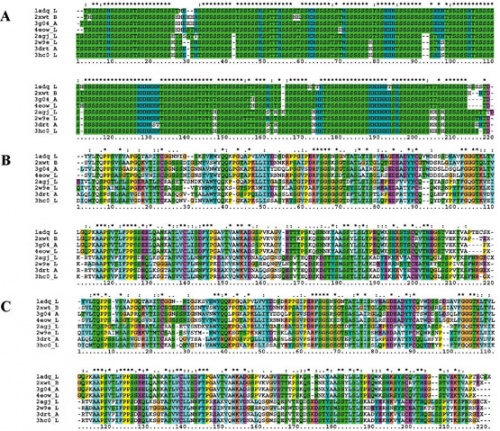
Further, a multiple alignment technique for proteins called supersecondary structure code (SSC) has been newly developedfrom thesupersecondary structure homology (SSH) technique of proteins with different amino acid sequences. This alignment code can be applied to the multiple sequence alignment in a way that is similar to what, ClustalX(Larkin, M. A.; Blackshields, G.; Brown, N. P.; Chenna, R.; McGettigan, P. A.; McWilliam, H.; Valentin, F.; Wallace, I. M.; Wilm, A.; Lopez, R.; Thompson, J. D.; Gibson, T. J.; Higgins, D. G. Clustal W and Clustal X version 2.0. Bioinformatics2007, 23, 2947-2948) is able to do based on amino acid sequence homology. The conformational difference between immunogloblinsand autoantibodies such as IgM rheumatoid factor could not especially be mined by the usual methodssuch as ClustalX. This multiple sequence alignment method derived from the alignment based on the supersecondary structure can also increase the accuracy of alignment.
Figure Legend
Multiple alignmentof the proteins correlated with light chain ofIgM rheumatoid factor (1adq: human). Supersecondary structure code (SSC) alignment (H:Alpha-helix-type, S:Beta-sheet-type, T: other-type, and D: disorder residue or C-terminal) (A), sequence alignment derived from the SSC alignment based on the supersecondary structure (B), and ClustalXmultiple sequence alignment (C).