Advances in Engineering Advances in Engineering features breaking research judged by Advances in Engineering advisory team to be of key importance in the Engineering field. Papers are selected from over 10,000 published each week from most peer reviewed journals.

Chemistry – An Asian Journal, Volume 8, Issue 4, pages 690–693, 2013.
Michiyasu Sakagami, Prof. Dr. Takahiro Sasamori, Dr. Heisuke Sakai, Prof. Dr. Yukio Furukawa, Prof. Dr. Norihiro Tokitoh.
Institute for Chemical Research, Kyoto University, Gokasho, Uji, Kyoto 611-0011 (Japan) &
Department of Chemistry and Biochemistry, School of Advanced Science and Engineering, Waseda University, 3-4-1 Okubo, Shinjuku-ku, Tokyo 169-8555 (Japan).
Information from the Authors:
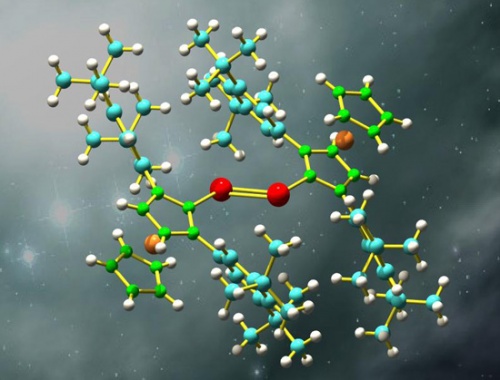
We have developed a very bulky ferrocenyl substituent, 2,5-bis(3,5-di-t-butylphenyl)1-ferrocenyl group. By utilizing the newly designed bulky ferrocenyl group, unique 1,2-Bis(ferrocenyl)dipnictenes bearing a heavier main-group-element π-spacer (Sb=Sb and Bi=Bi) between two ferrocenyl units have been synthesized as stable compounds. Not only their molecular structures and fundamental properties but also their redox behavior have been systematically disclosed. Interestingly, in the reduction region, they showed two pseudo-reversible one-electron redox couples at low temperature, suggesting possible generation of the corresponding radical anion and dianion species. On the other hand, they showed three-steps one-electron oxidation processes in the oxidation region, showing generation of the corresponding cationic species with relatively stable mixed-valence states. Thus, these 1,2-bis(ferrocenyl)dipnictenes with a Pn=Pn (Pn = Sb, Bi) π-spacer should be stable multi-redox systems reflecting unique properties of double-bond between heavier 15 group elements. As a result, Sb=Sb and Bi=Bi units were found to work as a more effective π-spacer than those of 2nd row elements such as C=C and N=N.