Advances in Engineering Advances in Engineering features breaking research judged by Advances in Engineering advisory team to be of key importance in the Engineering field. Papers are selected from over 10,000 published each week from most peer reviewed journals.

Applied Surface Science, Volume 283, 2013, Pages 309-320.
Wei Wang, Shaowen Ji, Ilsoon Lee.
Department of Chemical Engineering and Materials Science, Michigan State University, East Lansing, MI 48824, USA
Abstract
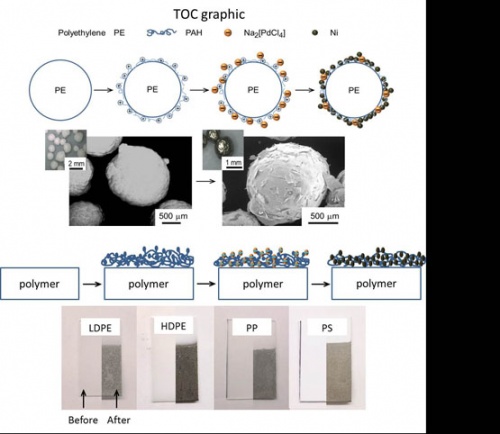
In this work, a facile “dip & rinse” method for nickel (Ni) electroless deposition on hydrophobic polymer surfaces is reported. The hydrophobic interactions between poly(allylamine hydrochloride) (PAH) and polymer substrates in an aqueous condition help eliminate the need for toxic and/or harsh surface treatment steps for catalyst adsorption/immobilization. Various hydrophobic polymer surfaces with different geometries and dimensions (i.e., thin sheets and pellets), including low density polyethylene (LDPE), high density polyethylene (HDPE), polypropylene (PP) and polystyrene (PS) thin sheets, as well as polyethylene (PE) pellets were tested. In all experiments, Ni was successfully deposited onto these hydrophobic polymer surfaces. Studies showed that, without the PAH, Ni coating was not able to form on any of these surfaces. Kinetic studies on polymer thin sheets examples showed that, with 2 h of deposition, an approximately 2 um thickness was achieved. Finally, a prove-of-concept study showed that Ni coated polymer thin sheets can be further electroplated with heterogeneous metal (Cu). An approximately 15 um thickness was gained in 1 h of electrodeposition.
Additional Information
Metal deposition onto heterogeneous materials (also referred to as “metallization”) is of wide interest because merits of metals can be possibly added to various substrates. The improved overall properties are usually ascribed to the properties associated with metals, such as abrasion resistance, friction reduction, electrical and thermal conductivity, or even mechanical hardening. However, the complexity of the research usually exists due to the inherent lack of affinity between the metal and substrate. The metal deposition onto polymer is a typical example.
Due to its equipment simplicity and flexibility, electroless metal deposition is one of the most employed strategies.It usually includes three major steps: 1) a surface treatment or conditioning; 2) application of an appropriate catalyst (typically noble metal catalyst, e.g. tin, palladium) on the substrate surface; 3) metal electroless deposition. Rinsing is required between the steps. However, in the first step, in order to modify the functionality of the substrate surface so that catalyst can be sequentially attached, harsh or/and toxic surface conditioning steps are usually employed. These surface conditionings include a harsh chemical etching (e.g. sulfuric and chromic acids), or a plasma treatment, or a UV source radiation, or a laser induced seeding. Those treatment/conditioning processes usually involve in harsh/toxic chemical handing that could harm the concerned personal, or/and sophisticated equipment that is expensive to acquire/replace. Both will increase the manufacturing cost.
In this work, we report a facile “dip & rinse” method for nickel (Ni) electroless deposition on hydrophobic polymer surfaces. The hydrophobic interactions between Poly (allylamine hydrochloride) (PAH) and polymer substrates in an aqueous condition help eliminate the need for toxic and/or harsh surface treatment steps for catalyst adsorption/immobilization. Various hydrophobic polymer surfaces with different geometries and dimensions (i.e., thin sheets and pellets), including low density polyethylene (LDPE), high density polyethylene (HDPE), polypropylene (PP) and polystyrene (PS) thin sheets, as well as polyethylene (PE) pellets were tested. In all experiments, Ni was successfully deposited onto these hydrophobic polymer surfaces. Studies showed that, without the PAH, Ni coating was not able to form on any of these surfaces. Kinetic studies on polymer thin sheets examples showed that, with 2 hours of deposition, a Ni film of approximately 2 µm thickness was achieved. Finally, a prove-of-concept study showed that Ni-coated polymer thin sheets can be further electroplated with heterogeneous metal (Cu). An approximately 15 um thickness was gained in 1 hour of electrodeposition.
Other related papers/patents from Professor Ilsoon Lee group at the Michigan State University
- Wang, W.; Burgueño, R.; Hong, J.; Lee, I. “Nano-deposition on 3-D open-cell aluminum foam materials for improved energy absorption capacity,” Materials Science and Engineering A572, 75-82, (2013).
- Sun, Y.; Burgueño, R.; Vanderklok, A.J.; Tekalur, S.A.; Wang, W.; Lee, I. “Compressive Behavior of Aluminum/Copper Hybrid Foams under High Strain Rate Loading,” Materials Science and Engineering A592, 111-120, (2014).
- Sun, Y.; Burgueño, R.; Wang, W.; Lee, I. “Effect of Annealing on the Mechanical Properties of Nanocopper Reinforced Open-cell Aluminum Foams,” Submitted, (2014).
- Sun, Y.; Burgueño, R.; Wang, W.; Lee, I. “Modeling and Simulation of the Quasi-static Compressive Behavior of Al/Cu Hybrid Open-cell Foams,” Submitted, (2014).
- Hendricks, T. R.; Dams, E. E.; Wensing, S. T.; Lee, I. “Effects of Catalyst Introduction Methods Using PAMAM Dendrimers on Selective Electroless Nickel Deposition on Polyelectrolyte Multilayers,” Langmuir23, 7404 -7410, (2007).
- Ahn, J. S.; Hendricks, T. R.; Lee, I. “Control of Specular and Diffuse Reflection of Light Using Particle Self-Assembly at the Polymer and Metal Interface,” Advanced Functional Materials17, 3619 – 3625,(2007).
- Srivastava, D.; Hendricks, T. R.; Lee, I. “Step-edge Like Template Fabrication of Polyelectrolyte Supported Nickel Nanowires,” Nanotechnology18 245305-245310, (2007).
- Hendricks, T. R.; Lee, I. “A Versatile Approach to Selective and Inexpensive Copper Patterns Using Polyelectrolyte Multilayer Coatings,” Thin Solid Films515, 2347–2352, (2006).
- Lee, I.; Hammond, P. T.; Rubner, M. F. “Selective Electroless Nickel Plating of Particle Arrays on Polyelectrolyte Multilayers,” Chemistry of Materials 15, 4583-4589, (2003).
- Lee, I.;Wang, W.; Gokhale, A.A. “A facile “dip & rinse” method of metal coating on various neutral hydrophobic surfaces,” MSU invention Disclosure Filed (TEC2013-0046-01Prov.; HDP 6550-000241/US/PS1), Oct. 2012.
- Lee, I.;Drzal, L.T.; Lu, J.; Hendricks, T.R. “MICROPATTERNING OF CONDUCTIVE GRAPHITE PARTICLES USING MICROCONTACT PRINTING , ,” US Patent Application 13/619696, Jan. 10, (2013).
- Lee, I.; Hendricks, T.R. “Selective metal patterns using polyelectrolyte multilayer coatings“US Patent Application US 2008/0014356 A1, Jan. 17, (2008).