Advances in Engineering Advances in Engineering features breaking research judged by Advances in Engineering advisory team to be of key importance in the Engineering field. Papers are selected from over 10,000 published each week from most peer reviewed journals.

Appl. Phys. Lett. 103, 093302 (2013).
Sebastian Reineke1,2, Nico Seidler3, Shane R. Yost1,4, Ferry Prins1,5,William A. Tisdale1,5 and Marc A. Baldo1,2
1 Energy Research Frontier Center for Excitonics, Massachusetts Institute of Technology, 77 Massachusetts Avenue, Cambridge, Massachusetts 02139, USA and
2 Department of Electrical Engineering and Computer Science, Massachusetts Institute of Technology, 77 Massachusetts Avenue, Cambridge, Massachusetts 02139, USA and
3 Department of Physics and Astronomy and London Centre for Nanotechnology, University College London, Gower Street, London WC1E 6BT, United Kingdom and
4 Department of Chemistry, Massachusetts Institute of Technology, 77 Massachusetts Avenue, Cambridge, Massachusetts 02139, USA and
5 Department of Chemical Engineering, Massachusetts Institute of Technology, 77 Massachusetts Avenue, Cambridge, Massachusetts 02139, USA.
Abstract
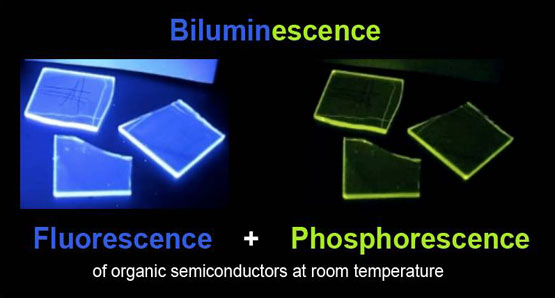
We report highly efficient, simultaneous fluorescence and phosphorescence (74% yield) at room temperature from a single molecule ensemble of (BzP)PB [N,N′-bis(4-benzoyl-phenyl)-N,N′-diphenyl-benzidine] dispersed into a polymer host. The slow phosphorescence (208 ms lifetime) is very efficient (50%) at room temperature and only possible because the non-radiative rate for the triplet state is extremely low (2.4 × 100 s−1). The ability of an organic molecule to function as an efficient dual state emitter at room temperature is unusual and enables a wide range of applications including the use as broadband down-conversion emitters, optical sensors and attenuators, exciton probes, and spin-independent intermediates for Förster resonant energy transfer.