Advances in Engineering Advances in Engineering features breaking research judged by Advances in Engineering advisory team to be of key importance in the Engineering field. Papers are selected from over 10,000 published each week from most peer reviewed journals.

Electrochemistry Communications, Volume 29, 2013, Pages 55-58.
Ryota Yamaguchi, Ayu Sato, Shiho Iwai, Kazuaki Tomono, Masaharu Nakayama
Materials Chemistry, Graduate School of Science and Engineering, Yamaguchi University, 2-16-1 Tokiwadai, Ube 755-8611, Japan
Abstract
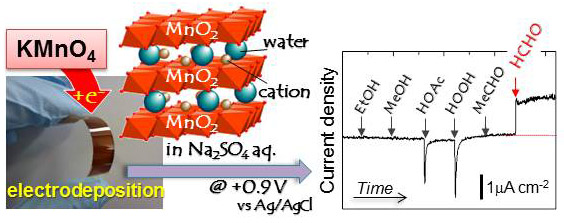
A novel electrochemical sensor for the detection of formaldehyde with high sensitivity and good selectivity was fabricated, which is composed of a low cost and environmentally benign MnO2 film, and not of noble metals or biological components. The MnO2 film was grown on a glassy carbon electrode from aqueous KMnO4 solution via a cathodic mechanism, possessing low crystalline birnessite structure and pseudocapacitive characteristics.
Significance Statement
The MnO2 film can also be fabricated on ITO-coated PET film and carbon cloth with large surface area and flexibility. A brown color due to d-d transition of Mn4+ is seen with naked eyes. The sensor electrode was not accompanied by surface poisoning due to intermadiate species, allowing the repetitive use. A linear relationship was observed in a wide formaldehyde concentration region of 0.02 to 10 mM with sensitivities of 21.43 (0.02–0.2 mM), 15.46 (0.2–2 mM), and 9.05 mA/M cm2 (2–10 mM), together with good selectivity against other small organic moleucles.