Advances in Engineering Advances in Engineering features breaking research judged by Advances in Engineering advisory team to be of key importance in the Engineering field. Papers are selected from over 10,000 published each week from most peer reviewed journals.

Significance Statement
Today, road transportation is responsible for a significant share in the total emissions of toxic matters that are known to cause adverse health effects. To counteract these emissions, more than 50 years ago the first emission regulations for passenger cars were issued and have become increasingly stringent over the past decades. To comply with the emission legislation over the whole lifetime of the vehicle, monitoring of all emission-relevant devices currently is prescribed by the on-board diagnosis (OBD) regulations. Wide-range oxygen sensors are often subject to fouling and aging due to the harsh environment to which they are exposed to in the exhaust pipe of internal combustion engines. Since these sensors are relevant for various emission reduction control systems, the monitoring of their static and dynamic behavior is prescribed by the latest OBD regulations. The article proposes an approach that enables the compliance with current and expected future regulations related to the monitoring of exhaust gas oxygen sensors.
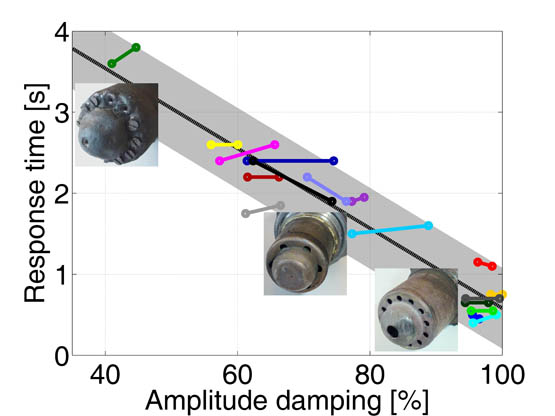
The approach presented exploits the presence of the pressure pulsations in the exhaust pipe that are caused by the reciprocating behavior of the engine. Conventional monitoring approaches require an active external excitation or a sufficient dynamic excitation to be induced by the driver. The approach presented here makes use of the fact that wide-range oxygen sensors are sensitive to the oxygen concentration as well as to the absolute pressure. Hence, the pressure pulsations represent a dynamic excitation of the oxygen sensor. Clogged holes of the protection tube of the oxygen sensor damp the pressure pulsations and slow down the sensor response. The relationship between the damping and the sensor response is analyzed by simulations and experiments. The sensor time constant is shown to be monitored with an average absolute accuracy of 0.25-0.3 s. As a major advantage the approach features continuous monitoring of the sensor dynamics even during stationary engine operation. Therefore, the proposed approach is particularly suitable for applications where the engine experiences short-time and mainly stationary operation. Such operating scenarios are found for instance in hybrid electric vehicles, electric vehicles with range-extender engines, stationary electricity generators and various types of off-road engine applications.
Journal Reference
Sensors and Actuators B: Chemical, Volume 191, 2014, Pages 384–395. Michael M. Moser, Christopher H. Onder , Lino Guzzella.
Institute for Dynamic Systems and Control, ETH Zurich, Sonneggstrasse 3, CH-8092 Zurich, Switzerland.
Abstract
Wide-range oxygen sensors are widely used for the air–fuel ratio control in lean operation engines. However, the harsh environment in the exhaust pipe can deteriorate the sensor dynamics. Therefore, to satisfy emission legislation over the lifetime of the sensor, its dynamics must be monitored continuously. Conventional approaches for the diagnosis of sensor dynamics require for active external excitation or sufficient dynamic excitation induced by the driver. To overcome this dependency, this paper presents a new approach, which makes use of the sensor excitation caused by the reciprocating behavior of the engine that induces pressure pulsations in the exhaust pipe. The approach exploits the fact that wide-range oxygen sensors measure the oxygen partial pressure, which is proportional to the oxygen concentration as well as to the total pressure. Clogged protection tube holes of the oxygen sensor damp the pressure pulsations and slow down the sensor response. The relationship between the damping and the sensor response is analyzed with simulations and experiments. It is shown that the sensor time constant can be monitored with an average absolute accuracy of 0.25–0.3 s. Due to the continuous monitoring capability, the proposed approach is particularly suitable for applications where the engine experiences short-time and mainly stationary operation. Moreover, the proposed approach can be efficiently combined with conventional monitoring algorithms.