Advances in Engineering Advances in Engineering features breaking research judged by Advances in Engineering advisory team to be of key importance in the Engineering field. Papers are selected from over 10,000 published each week from most peer reviewed journals.

Polymer Composites, Volume 35, Issue 4, pages 671–680, 2014. Peter H. Foss1,*, Huan-Chang Tseng2, John Snawerdt2, Yuan-Jung Chang2, Wen-Hsien Yang2 and Chia-Hsiang Hsu2
ABSTRACT
In the automotive industry, glass-filled thermoplastics are used in air intake manifolds, radiator tanks, and many other parts. However, widespread application of glass-filled thermoplastic materials has been limited in many cases by the inability to accurately predict performance and durability. Since a more accurate fiber orientation prediction will lead to more accurate local mechanical property predictions, this work investigated a recently proposed mathematic model of fiber suspension rheology, which considers the anisotropic fiber diffusion and fiber–matrix interaction from a microscopic viewpoint. The new model proved able to predict many details of the fiber orientation distribution and could be applied advantageously as part of the product and manufacturing development processes. © 2013 Society of Plastics Engineers.
Significance Statement
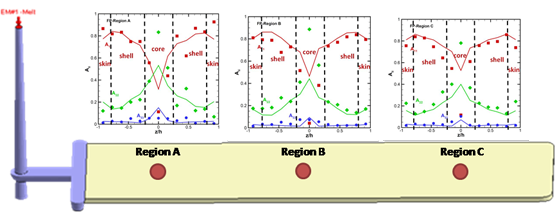
Fiber reinforced thermoplastic (FRT) composites continue to show strong growth in automotive application, as replace metal. Their benefit is superior mechanical properties of strength, stiffness, and impact, which are primarily influenced by fiber orientation. Recently, Moldex3D proposed a new fiber three-parameter orientation model, namely, the iARD-RPR model (the Improved Anisotropic Rotary Diffusion model combined with the Retarding Principal Rate model). The iARD-RPR model not needing the so-called inlet condition is attentive in injection molding simulations of FRT composites. In 2013, the United States Patent and Trademark Office granted Moldex3D a new patent (U.S. Patent No. 8,571,828) for the innovative technology of the iARD-RPR model, namely that brings high-accuracy prediction to the orientation distribution of injection-molded fiber-reinforced thermoplastics and can be applied to a wide range of injection molding needs. In this work, we perform the accurate fiber orientation calculations during injection filling for PBT (Polybutylene Terephthalate) with reinforcement of 30wt.% short glass fiber, as compared with related experimental data. It is significant to discuss the well-known skin-shell-core structure of fiber orientation distribution.