Advances in Engineering Advances in Engineering features breaking research judged by Advances in Engineering advisory team to be of key importance in the Engineering field. Papers are selected from over 10,000 published each week from most peer reviewed journals.

Metallurgical and Materials Transactions B, January 2015.
Xiang Li (1) ,Guangqing Zhang (1),Kai Tang (2),Oleg Ostrovski (3),Ragnar Tronstad (4)
1. School of Mechanical, Materials and Mechatronic Engineering, University of Wollongong, Wollongong, NSW, 2522, Australia.
2. SINTEF Materials and Chemistry, 7465, Trondheim, Norway.
3. School of Materials Science and Engineering, University of New South Wales, Sydney, NSW, 2052, Australia.
4. Elkem AS, Hoffsveien 65B, 0377, Oslo, Norway.
Abstract
This article examines the influence of gas atmosphere on the synthesis of silicon carbide by carbothermal reduction of quartz. The quartz was crushed to <70 μm, uniformly mixed with graphite and pressed into pellets. Reduction was studied in isothermal and temperature-programmed reduction experiments in a tube reactor in argon, hydrogen and Ar-H2 gas mixtures. The concentrations of CO, CO2, and CH4 in the off gas were measured online using an infrared gas analyzer. The samples after reduction were characterized by X-ray diffraction, scanning electron microscope, and LECO analyzer. The carbothermal reduction of quartz in hydrogen was faster than in argon. Formation of silicon carbide started at 1573 K (1300 °C) in argon, and 1473 K (1200 °C) in hydrogen. Synthesis of silicon carbide in hydrogen was close to completion in 270 minutes at 1673 K (1400 °C), 140 minutes at 1773 K (1500 °C), and 70 minutes at 1873 K (1600 °C). Faster carbothermal reduction rate in hydrogen was attributed to the involvement of hydrogen in the reduction reactions by directly reducing silica and/or indirectly, by reacting with graphite to form methane as an intermediate reductant.
Go To Metallurgical and Materials Transactions B
Significance Statement
Carbothermal reduction is the primary commercial process for the synthesis of many non-oxide ceramic powders, particularly silicon carbide (SiC). Recent work demonstrated that the gas atmosphere has a strong effect on the kinetics of carbothermal reduction of manganese oxides, titania and alumina, while the effect of gas atmosphere on carbothermal reduction of silica has been studied to a lesser extent.
This work by Xiang Li et al. investigated the carbothermal reduction of quartz in argon and hydrogen containing gas. The aim of this article was to establish the effects of temperature and gas composition on the extent, rate, and mechanisms of carbothermal reduction of quartz.
The reduction rate increased with increasing hydrogen partial pressure and temperature. SiC began to form at 1473 K (1200 °C) in hydrogen. The conversion of quartz to SiC at 1673 K (1400 °C) was completed in 270 minutes. This duration was reduced to 140 minutes at 1773 K (1500 °C) and 70 minutes at 1873 K (1600 °C). In the carbothermal reduction of SiO2 in argon, the conversion of quartz to SiC started at 1573 K (1300 °C), and was incomplete after 270 minutes at 1773 K (1500 °C). The faster reduction rate in hydrogen containing gas was attributed to the involvement of hydrogen in the reactions. Quartz was directly reduced by hydrogen to gaseous SiO; CH4 formed by reacting hydrogen with graphite also accelerated reduction of quartz to SiC.
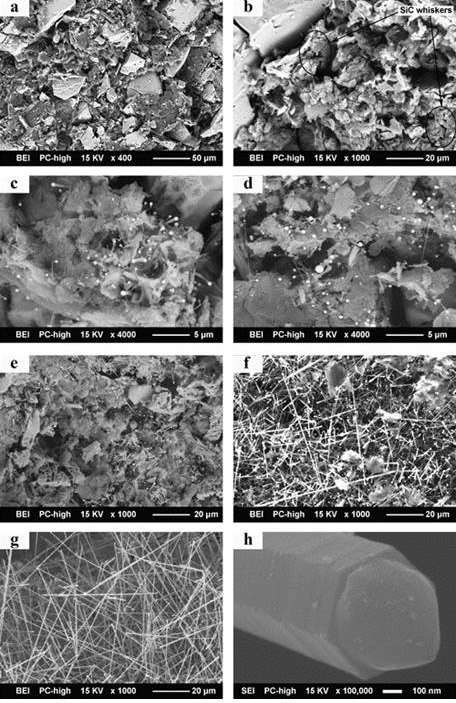
The reaction between CH4 and SiO resulted in growth of SiC whiskers under catalytic effect of iron. SiC whiskers with diameter of 0.4–0.8 μm started to grow from 1673 K (1400 °C) following VSL mechanism. Whisker length increased with the increase of temperature. The yield of whiskers was higher on the surface than the interior of a pellet.
Figure Legend
SEM images of quartz in the progress of temperature programmed reduction in pure hydrogen. The furnace temperature was ramped from 573 K (300 °C) to different temperatures at 3 K/min: (a) at 1573 K (1300 °C), cross section; (b) and (c) 1673 K (1400 °C), cross section; (d) 1673 K (1400 °C), surface; (e) 1773 K (1500 °C), cross section; (f) 1773 K (1500 °C), surface; (g) 1873 K (1600 °C), surface; (h) 1873 K (1600 °C), a SiC fibre at a high magnification.