Advances in Engineering Advances in Engineering features breaking research judged by Advances in Engineering advisory team to be of key importance in the Engineering field. Papers are selected from over 10,000 published each week from most peer reviewed journals.

Composite Structures, Volume 119, 2015, Pages 174–184.
Michael M. Porter1, Luis Meraz2, Albert Calderon2, Hyunjae Choi2, Amer Chouhan2, Leon Wang3, Marc A. Meyers1, 2, 4, Joanna McKittrick1, 2
1. Materials Science and Engineering Program, University of California, San Diego, 9500 Gilman Drive, La Jolla, CA 92093, United States.
2. Department of Mechanical and Aerospace Engineering, University of California, San Diego, 9500 Gilman Drive, La Jolla, CA 92093, United States.
3. Department of Bioengineering, University of California, San Diego, 9500 Gilman Drive, La Jolla, CA 92093, United States.
4. Department of Nanoengineering, University of California, San Diego, 9500 Gilman Drive, La Jolla, CA 92093, United States.
Abstract
Helix-reinforced structures are found in a variety of natural materials, from the helical architecture of the narwhal tusk to the Bouligand structures in the exoskeletons of crustaceans. Drawing inspiration from these natural structures, a novel materials processing method, known as magnetic freeze casting, is used to fabricate helix-reinforced hybrid composites. The ZrO2–epoxy composites investigated here exhibit enhanced torsional properties due their helical architectural organization. In torsion, the maximum tensile and compressive stresses induced by a state of pure shear are oriented at ±45° to the axis of rotation. As a result, the composites with helix-reinforcement oriented parallel to the direction of maximum compressive stress (at ∼45°) exhibit the highest shear moduli. Bioinspired, hybrid composites with helix-reinforced structures may be useful for a variety of engineering applications, from the cylindrical shafts in combustion engines to golf clubs and bone implants.
Significance Statement
Naturally occurring helices found in the stems of woody plants and the skeletons of silica sponges reinforce against torsion induced stresses caused by wind and ocean currents. Inspired by these functional designs, a new ceramics processing method known as magnetic freeze casting was used to fabricate helix-reinforced ceramic-based composites that exhibit enhanced torsional properties. The helical architectures were formed by rotating a magnetic field around a freezing magnetic fluid containing ceramic particles. After freezing, the ceramic-based materials were lyophilized (freeze-dried), sintered (heat-treated), and infiltrated with polymers to further reinforce the structures. Mechanical testing and analytical results show that the orientation and direction of the helices significantly affect the performance of the functionally-graded composites; in some cases, the strength and stiffness increased more than 2X that of similar, non-reinforced homogeneous composites.
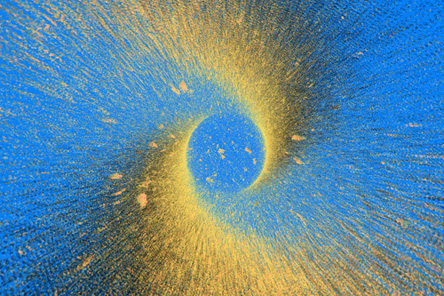
Figure Caption: Micro-computed tomography image of a helix-reinforced ceramic-based composite. The yellow helices illustrate the functionally-graded architecture that reinforces the structures.