Advances in Engineering Advances in Engineering features breaking research judged by Advances in Engineering advisory team to be of key importance in the Engineering field. Papers are selected from over 10,000 published each week from most peer reviewed journals.

Significance Statement
The use of sol-gel derived monosize silica spheres in the nanometer size range can make the nanodesign of porous materials for specific applications like membranes with interconnected pore structures, catalysts and photonic band gap crystals possible. A predefined pore structure can be easily designed by varying the diameter and the packing behaviour of monodisperse silica spheres. The size of the silica spheres prepared by the Stober process is mainly controlled by the relative rates of nucleation and growth. In the last couple of decades extensive work have been conducted for the development of a better understanding on the formation and growth mechanisms of the monodisperse silica spheres by using different techniques including Si-NMR, photon correlation spectroscopy, small angle X-ray scattering, and dynamic light scattering. The growth and structural development of spheres occur through either diffusion-limited or reaction-limited processes. The effect of sol-gel process parameters on the final sphere size in a relatively wide range (5 to 520 nm) was investigated in this work. Diffusive growth has been determined from Nielsen chronomal analysis for the 520 and 310 nm monodisperse silica spheres.
The use of monodisperse silica spheres for the theoretical interpretations of sintering models has been also the subject of considerable body of work. Viscous flow is the dominating transport mechanism for amorphous material sintering while the crystalline materials sinter by solid-state diffusion. Analysis of the dominant sintering mechanism is one of the challenges due to the relatively complicated nature of the microstructural evolution in the course of sintering depending on the initial powder properties/microstructure. Dilatometric analysis was used to establish a better understanding of the relationships between the particle size and the densification behaviour of monodisperse silica sphere compacts.
Figure Legend
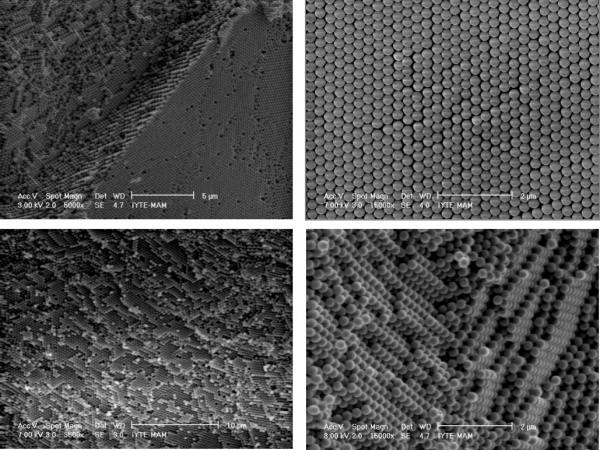
SEM micrographs of 310 nm sphere (a) ordered compacts (5kX), (b) top surface (15kX), (c) fracture surface (3.5kX) and (d) fracture surface (15kX).
Journal Reference
Berna Topuz, Deniz Şimşek, Muhsin Çiftçioğlu. Ceramics International, Volume 41, Issue 1, Part A, 2015, Pages 43-52.
Chemical Engineering Department, İzmir Institute of Technology, Urla, İzmir, Turkey.
Abstract
Monodisperse silica spheres in the 50–520 nm size range were prepared by using the Stober process. Diffusive growth has been determined from Nielsen chronomal analysis for the 520 and 310 nm monodisperse silica spheres. The densification behaviour and evolution of the microstructure of the sphere compacts indicated an inverse dependence of shrinkage rate on the sphere size due to viscous sintering. The increase in sphere size from 50 to 500 nm shifted the densification temperature from ~1120 °C to 1240 °C. The amorphous nature of the spheres was conserved up to 1200 °C where cristobalite crystal nucleation started and complete transformation to cristobalite phase has been observed upon heat treatment at 1300 °C. The activation energies for viscous sintering according to the Frenkel and Mackenzie/Shuttleworth models were calculated as 125 and 335 kJ/mol, respectively. These substantially low activation energies can be attributed to the presence of a significant level of silanol groups.