Advances in Engineering Advances in Engineering features breaking research judged by Advances in Engineering advisory team to be of key importance in the Engineering field. Papers are selected from over 10,000 published each week from most peer reviewed journals.

Significance statement
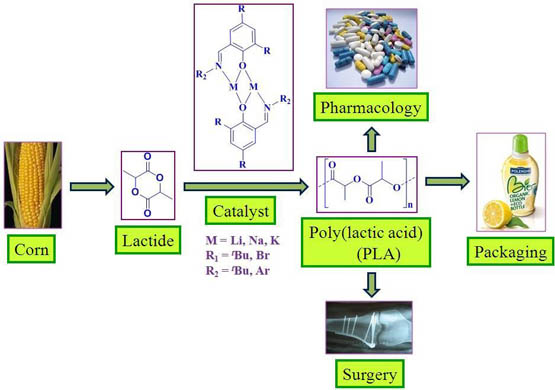
Due to their unique properties such as bio-renewability, biodegradability, biocompatibility and permeability, poly(lactic acid) (PLA) has been considered as an alternative environmentally friendly polymer derived from annually renewable resources such as corn and sugar beet and it is a potential replacement material for plastics derived from petrochemical resources. PLA has shown valuable applications in biomedical engineering such as controlled drug delivery systems, orthopedic fixation devices, sutures, dental devices and tissue engineering. Concerting about biomedical functions of PLA, it is most important that the catalyst rests found in the produced PLA are potentially nontoxic and should be absorbed or metabolized in the body without any side effects. Based on these fundamental requirements, we used nontoxic lithium, sodium and potassium imino(phenoxide) complexes for the synthesis of PLA. It’s quite easy to synthesize these compounds in high yields and purity. These complexes showed enhanced catalytic activity towards the bulk ring opening polymerization of lactides in solvent free conditions at 140 °C in an extremely short span of time with quantitative conversion and very high turnover frequencies. The produced PLA showed admirable stereoselectivity which has practical consequences on its properties. In the presence of benzyl alcohol as a co-initiator, these complexes demonstrated better catalytic activity producing polymer with enhanced stereoselectivity. PLA derived from the sodium salts showed a good correlation between the observed molecular weight and the predicted molecular weight.
Journal Reference
Swarup Ghosh1, Debashis Chakraborty2, Babu Varghese3. European Polymer Journal, Volume 62, 2015, Pages 51–65.
[expand title=”Show Affiliations”]- Department of Chemistry, Indian Institute of Technology Madras, Chennai 600 036, Tamil Nadu, India.
- Department of Chemistry, Indian Institute of Technology Patna, Patna 800 013, Bihar, India
- Sophisticated Analytical Instruments Facility, Indian Institute of Technology Madras, Chennai 600 036, India.
Abstract
A series of lithium, sodium and potassium salts containing various iminophenoxide ligand scaffolds have been successfully synthesized in high yields and purity. These complexes were completely characterized with different spectroscopic techniques and single crystal X-ray diffraction studies on a few of them. These compounds were found to be active towards the solvent free ring opening polymerization (ROP) of L-lactide (L-LA) and rac-lactide (rac-LA), yielding polymers with high number average molecular weight (Mn) and controlled molecular weight distribution (MWDs). Poly(lactic acid) (PLA) derived from the ROP of lactides using the Na complexes showed a close proximity between the observedMn and theoretical molecular weight (Mntheo). In addition, the MWDs were found to be narrow. These complexes were also found to be active for the ROP of lactides in the presence of benzyl alcohol as a co-initiator. The kinetics and mechanistic studies associated with these polymerizations have been performed and reported.
Go To European Polymer Journal