Advances in Engineering Advances in Engineering features breaking research judged by Advances in Engineering advisory team to be of key importance in the Engineering field. Papers are selected from over 10,000 published each week from most peer reviewed journals.

J.B. Hinwood, E.J. McLean, B.C. Wilson
Coastal Engineering, Volume 61, March 2012
Abstract
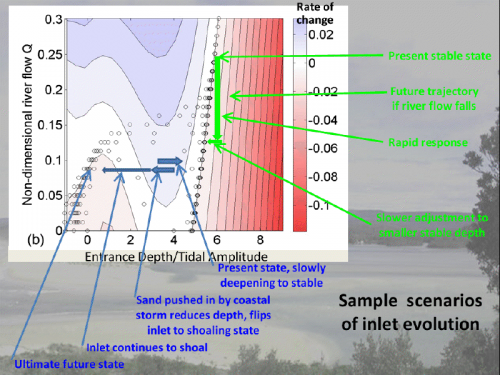
Many small estuaries comprise a tidal basin linked to the sea by a constricted entrance channel, itself formed by the tidal and fluvial flows. Its dimensions control the tidal, salinity and water quality regimes within the estuary. Methods of non-linear dynamics have been applied to discover and characterise the attractors for the entrance channel. An attractor (node) is a quasi-equilibrium state to which the estuary evolves over time. Two attractors have been identified, one in which the entrance is tidally dominated, known crudely from field studies of tidal prism–entrance area relationships, and a new attractor in which the river flow dominates the hydrodynamics but the small tidal flow dominates the evolution. Attractor methods provide a powerful new tool for understanding and managing estuaries.
Non-linear dynamics and attractors for the entrance state of a tidal estuary
Jon Hinwood, Errol McLeanm and Bob Wilson
Department of Mechanical & Aerospace Engineering, Monash University, Victoria 3800, Australia
& Coastal Environmental Consultants Pty Ltd, Melbourne
School of Earth and Environmental Sciences, University of Wollongong, Wollongong, NSW, Australia
& Geomax, Kiama, NSW
Contacts: Jon Hinwood [email protected]
Errol McLean [email protected]
Understanding and predicting the long term evolution of an estuary is essential for sound management of these important natural systems. Changes such as diversion of catchment inflows or entrance training works can cause an estuary to dramatically change its character, affecting ecosystems, fisheries, navigation and shoreline erosion. The research reported in this paper offers a new way of looking at the possible changes and a powerful way of visualising the most likely changes. Decision support tools and their associated community information systems can benefit from the methods presented here.
This research is part of a long running program that has includes data collection and analysis, numerical modelling and implementation of Decision Support Systems for local government agencies. Other outputs of the study include simple mathematical models of estuarine physical processes, improved methods of time series data analysis, and field data sets for model calibration and validation.
Go to Journal