 Advances in Engineering Advances in Engineering features breaking research judged by Advances in Engineering advisory team to be of key importance in the Engineering field. Papers are selected from over 10,000 published each week from most peer reviewed journals.

Jee-Yun Choi, Dong-Ik Lee, Chan-Jin Kim, Chang-Ha Lee, Ik-Sung Ahn
Journal of Industrial and Engineering Chemistry
Volume 18, Issue 2, March 2012
Abstract
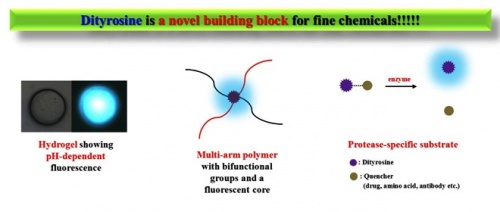
A poly(ethylene glycol) (PEG)-based hydrogel was synthesized by the copolymerization of PEG diacrylate (PEGDA) and PEG methacrylate (PEGMA) linked with N,N′-di(tert-butoxycarbonyl)-dityrosine (DBDY). Owing to the presence of the dityrosine derivative DBDY, the resulting hydrogel exhibited pH-dependent fluorescence and contained multi-functional groups (1 carboxylic acid group and 2 amine groups protected bytert-butoxycarbonyl groups). A high molecular mass chemical can be bound to DBDY in the hydrogel through one of these functional groups (i.e. the formation of amide bonding). Then the porosity of the resulting hydrogel is increased by the action of an enzyme such as proteinase. Also, if a drug is bound directly to DBDY, the enzyme can control its detachment. Hence, the PEGMA–DBDY hydrogel could be useful for drug release near the site of the disease where the expression level of a certain enzyme is especially high (e.g. matrix metalloproteinases in cancers). Binding of a UV-absorbing compound to DBDY was monitored by measuring the change in fluorescence intensity, which is known as the phenomenon of fluorescence resonance energy transfer (FRET).
Additional Information:
Dityrosine (DY) has lots of advantages as a building block for fine chemicals such as multi-functional groups for conjugation, fluorescence, biocompatibility, pH-stability. We have been doing world-leading researches of the synthesis of DY-derived fine chemicals such as hydrogels with pH-dependent fluorescence, star-shaped multi-arm fluorescent polymer, and protease-specific substrates [1-2]. These products are based on the large-scale production of DY at the lowest cost in the world.
[1] Chan-Jin Kim, Dong-Ik Lee, Chang-Ha Lee, Ik-Sung Ahn* AnalyticaChimicaActa, 723, 101-107, 2012.
[2] Dong-Ik Lee, Chan-Jin Kim, Chang-Ha Lee, Ik-Sung Ahn* Journal of Industrial and Engineering Chemistry, 18, 1186-1190, 2012.
Go to Journal
