Advances in Engineering Advances in Engineering features breaking research judged by Advances in Engineering advisory team to be of key importance in the Engineering field. Papers are selected from over 10,000 published each week from most peer reviewed journals.

Chaminda R. Samarage, Josie Carberry, Kerry Hourigan, Andreas Fouras
Experiments in Fluids, Volume 52, April 2012
Abstract
Particle Image Velocimetry (PIV) has become the gold standard for fluid flow field measurement over the last 20 years. In PIV, tracer particles are introduced to the fluid flow and illuminated using a laser source. Multiple images of the flow in a region of interest are captured using a digital camera. A cross-correlation is performed between two corresponding regions of image frames acquired at different times and the location of the cross-correlation peak yields a measure for the displacement of the underlying fluid flow.
In many circumstances it is desirable to average these measurements across time, reducing uncertainty in these measurements. Two methods of averaging have emerged each with distinct properties. Vector averaging, where displacement vectors are averaged in time, is known to produce improvements to measurement accuracy in optimal conditions. With correlation averaging, where the cross-correlation is averaged in time and the displacement is determined from the averaged cross-correlation map; is known to increase robustness in challenging conditions.
A hybrid of correlation and vector averaging is introduced to capitalise on the advantages of each process. An extensive series of Monte Carlo simulations have been conducted to investigate hybrid averaging and evaluate it against both vector and correlation averaging. The simulations show that hybrid averaging improves the measurement accuracy over both correlation and vector averaging over a wide range of imaging conditions. The simulations are validated by applying hybrid averaging to experimental micro and macro flows. In pulsatile conditions, correlation aver- aging yields an averaged correlation function that is multimodal, which can result in unpredictable measurements. A Monte Carlo simulation shows the benefits of hybrid averaging over correlation averaging in such conditions. This has been experimentally validated on the unsteady wake behind a shedding circular cylinder at Re=98.
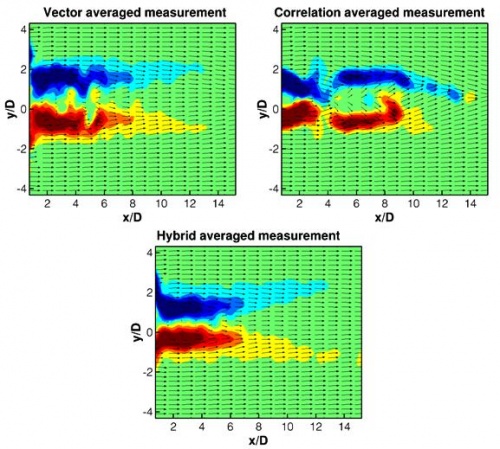
PIV measurements of the unsteady wake behind a circular cylinder at a Reynolds number of 98. Data are time averaged using vector averaging (left), correlation averaging (center) and hybrid averaging (right). The colour contours represent vorticity and vectors represent flow velocity.
Website: Laboratory for Dynamic Imaging http://ldi.monash.edu
Go to Journal