Advances in Engineering Advances in Engineering features breaking research judged by Advances in Engineering advisory team to be of key importance in the Engineering field. Papers are selected from over 10,000 published each week from most peer reviewed journals.

Andrzej Gągorowski
Central European Journal of Engineering June 2012, Volume 2, Issue 2, pp 264-278
Abstract
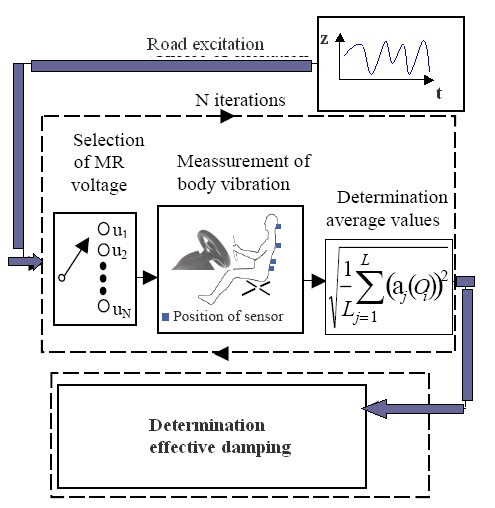
This paper presents an original approach to the problem of controlling a magnetorheological suspension of a driver’s seat for optimal reduction of whole-body vibration. The concept consists in taking into consideration the individual personal features (biomechanical parameters) of the driver in the control process of a MR damper by using human generated signals. The proposed algorithm enables the adaptation of the suspension for an individual driver and specific road conditions. The actual research has focused on numerical simulations with a complex model of the human-seat-vehicle system. The human model representing a specific driver has been described by several biomechanical parameters such as masses of body structures, moments of inertia, and stiffness and damping of the spine, intervertebral discs, spinal muscles and ligaments.
Additional Information
Whole-body vibrations have the greatest negative impact on human health and and driving comfort. Combined vibrations from vehicle and seat may generate undesirable resonance frequencies, which are unacceptable to the human body. The object of study is very broad, becouse it remains problems in many technical and medical areas. Transmission of vibration throughout the human structures is a complicated phenomenon because of nonlinearities in the human musculoskeletal system and soft tissues. For different drivers the responses to vibration can be different. Biomechanics of different drivers was determined by the choice of those parameters that have the greatest impact on transmission of vibrations throughout the human body.
The effective stiffness and damping can be adjusted by controlling the magnetorheological (MR) damper. The proposed concept of an ‘intelligent’ vehicle seat is based on new control system of the magnetorheological suspension including the biomechanics of the driver. The study included an analysis of complex human-vehicle-seat system. The presented results suggest that the proposed system give a large potential for reduction of dangerous vibration. It may provide more effective whole-body vibration control in a wider frequency range, when the damper is controlled.
Go to Journal