Advances in Engineering Advances in Engineering features breaking research judged by Advances in Engineering advisory team to be of key importance in the Engineering field. Papers are selected from over 10,000 published each week from most peer reviewed journals.

Enrico Bernardo, Paolo Colombo, Ilaria Cacciotti, Alessandra Bianco, Rossella Bedini, Raffaella Pecci, Karoline Pardun, Laura Treccani, Kurosch Rezwan
Journal of the European Ceramic Society Volume 32, Issue 2, February 2012, Pages 399–408
Abstract
Wollastonite–hydroxyapatite ceramics have been successfully prepared by a novel method, corresponding to the thermal treatment in air of a silicone embedding micro- and nano-sized fillers. CaCO3 nano-sized particles, providing CaO upon decomposition, acted as “active” filler, whereas different commercially available or synthesised hydroxyapatite particles were used as “passive” filler. The homogeneous distribution of CaO, at a quasi-molecular level, favoured the reaction with silica derived from the polymer, at only 900 °C, preventing extensive decomposition of hydroxyapatite. Open-celled porous ceramics suitable for scaffolds for bone–tissue engineering applications were easily prepared from filler-containing silicone resin mixed with sacrificial PMMA microbeads as templates. The pore size (in the range of 80–400 μm) and the open porosity percentage (40–50%) were evaluated by means of micro-computerized tomographic analysis. A preliminary assessment of the biocompatibility and cell activity of the produced ceramics was performed successfully by in vitro tests using human osteoblast cells.
Additional Information
Several silicate and oxynitride systems can be prepared by the application of the novel technique of preceramic polymers filled with micro- and nano-sized fillers [see Colombo et al., “Multifunctional Advanced Ceramics from Preceramic Polymers and Nano-Sized Active Fillers”, J Eur Ceram Soc 33 (2013) 453–469]. The fillers are intended to provide oxides directly reacting with the decomposition products of preceramic polymers, mainly consisting of silicone resins. When processing in air, silicones yield practically pure silica, and silica/oxide reactions generally lead to silicate ceramics in conditions of high phase purity and very favorable reaction kinetics, at low temperature.
The paper here presented was aimed at highlighting silicate-based biomaterials as a fundamental application of the new technology. In fact, one can exploit:
1) the bioactivity of calcium, magnesium and calcium-magnesium silicates, easily obtainable by using low cost CaO and MgO precursors (oxides, hydroxides, carbonates), reacting with the silica provided by oxidation of silicones;
2) the formation of macro- and micro-porosity, due to processing (plastic forming of polymer/filler composites, burn-out of sacrificial templates) and/or synthesis conditions (evolution of gasses from the ceramic conversion of the polymer, from the decomposition of fillers, etc.);
3) the low temperatures and short firing times required (e.g. wollastonite/hydroxyapatite composites here presented are produced at 900°C, with shaping performed before firing, whereas classical wollastonite-apatite glass-ceramics are developed by glass melting, shaping and subsequent ceramization).
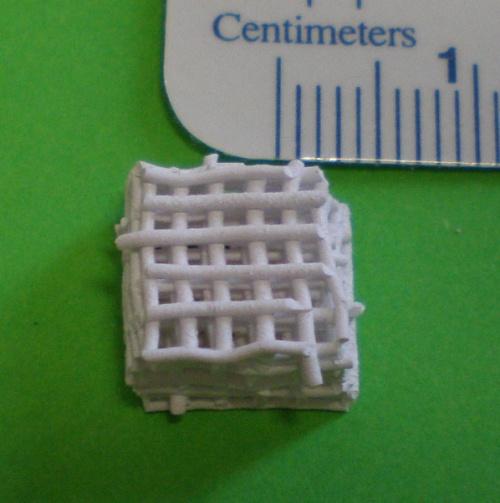
The present paper refers fillers introduced in silicone solutions; the shaping consisted of the manual pressing of “composite powders”, i.e. powders of silicone resin embedding micro- and nano-sized fillers, obtained after drying. Highly porous ceramics were obtained by oxidation of samples in turn prepared by mixing of powders with PMMA microbeads. Further developments, leading to porous ceramics with no need for solvents, sacrificial templates and complex shaping operations, however, are already available. In fact, extrusion has already been applied to the manufacturing of wollastonite-based three-dimensional scaffolds, as illustrated in the figure [see Bernardo et al., “Novel 3D Wollastonite-Based Scaffolds from Preceramic Polymers Containing Micro- and Nano-Sized Reactive Particles”, Adv Eng Mater 14 (2012) 269–74], or wollastonite-based foams (extrusion assisted by supercritical carbon dioxide) [see Bernardo et al., “Wollastonite Foams From an Extruded Preceramic Polymer Mixed with CaCO3 Microparticles Assisted by Supercritical Carbon Dioxide”, Adv Eng Mater, in press (2012) 10.1002/adem.201200202].
Ca-Mg silicates (e.g. akermanite ceramics) as well as on highly amorphous materials constitute the focus of current investigations.
Go to Journal