Advances in Engineering Advances in Engineering features breaking research judged by Advances in Engineering advisory team to be of key importance in the Engineering field. Papers are selected from over 10,000 published each week from most peer reviewed journals.

Surface and Coatings Technology, Volume 206, Issue 10, 25 January 2012, Pages 2638-2644
Tie-Gang Wang, Dawoon Jeong, Yanmei Liu, Qimin Wang, Srinivasan Iyengar, Solveig Melin, Kwang Ho Kim
National Core Research Center for Hybrid Materials Solution, Pusan National University, Busan 609-735, South Korea
Division of Materials Engineering, Lund University, Box 118, SE-22100 Lund, Sweden
State Key Laboratory of Corrosion and Protection, Institute of Metal Research, Chinese Academy of Sciences, Shenyang 110016, PR China
Analysis and Testing Division, Institute of Metal Research, Chinese Academy of Sciences, Shenyang 110016, PR China
School of Mechanical and Electronic Engineering, Guangdong University of Technology, Guangzhou 510006, PR China
Abstract
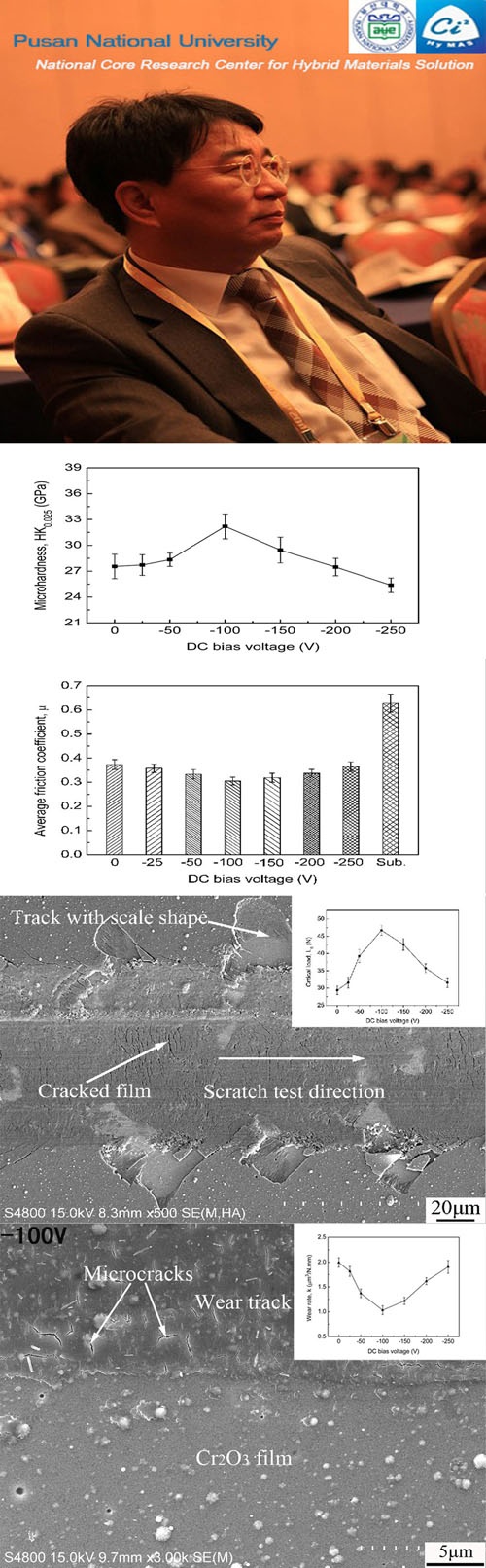
In this work, the influence of substrate bias voltage on the microhardness, adhesive strength, friction coefficient, and wear rate of AIP Cr2O3 films deposited on AISI 304 stainless steel substrates was investigated systematically. In the meantime, the wear failure mechanism of AIP Cr2O3 films in dry sliding contact was also analyzed and discussed. The results showed that the mechanical properties, adhesive behaviors, and tribological performance of AIP Cr2O3 films were greatly altered by applying a negative bias voltage. With increasing the bias voltage, the hardness, critical load, and tribological performance of AIP Cr2O3 films first were improved gradually, and then were impaired slightly again. When the bias voltage is − 100 V, the Cr2O3 film possessed the highest hardness, the strongest adhesion, and the best wear resistance. The essence of above phenomena was attributed to the variations of microstructure and defect density in the films induced by the substrate bias voltage increase. The main wear failure mechanism of AIP Cr2O3 films is crack initiation and propagation under the high contact stresses, inducing the local film with small area to flake off gradually, and eventually leading to the formation of a wear scar.
Additional Information
Prof. Kwang Ho Kim, is now the director of National Core Research Center for Hybrid Materials Solution (NCRC-HMS), director of National Research Laboratory (thin film division). He has successively filled various posts such as vice president of the Korean Institute of Ceramic Society, non-executive director of Korean Research Foundation, editorial board of Korean Union of Chemical Science and Technology Society, etc. His current research is focused on designing and investigating hybrid materials through multi-scale hybridization (macro scale, micro scale, atomic scale, crystalline/amorphous, inter- and intra- granular, etc.).
Based on our previous research [1], in which the influence of substrate bias voltage on the film growth process, microstructure, and characteristics, including the phase constituents, grain size, lattice constant, chemical compositions, as well as surface and cross-section morphologies were studied. In this work, we further investigate how the negative bias voltage affected the mechanical properties, adhesive behaviors, and tribological performance of AIP Cr2O3 films deposited on AISI 304 stainless steel substrates. And the wear failure mechanism of AIP Cr2O3 films in dry sliding contact was also explored.
With increasing the bias voltage, the hardness, critical load, and tribological performance of AIP Cr2O3 films first were improved gradually, and then were impaired slightly again. When the bias voltage is -100 V, the Cr2O3 film possessed the highest hardness, the strongest adhesion, and the best wear resistance. The essence of above phenomena was attributed to the variations of microstructure and defect density in the films induced by the substrate bias voltage increase.
The main wear failure mechanism of AIP Cr2O3 films is crack initiation and propagation under the high contact stresses, inducing the local film with small area to flake off gradually, and eventually leading to the formation of a wear scar. However, some defects in the films, especially macroparticles will promote the crack initiation and propagation, which would weaken the wear resistance of films.
[1] T.-G. Wang, D. Jeong, S.H. Kim, Q.M. Wang, S. Melin, S. Iyengar, K.H. Kim, Submitted to Surf. Coat. Technol. 206 (2012) 2629.Correspondent: [email protected] (Prof. Dr. Kwang Ho Kim)