Advances in Engineering Advances in Engineering features breaking research judged by Advances in Engineering advisory team to be of key importance in the Engineering field. Papers are selected from over 10,000 published each week from most peer reviewed journals.

Acta Astronautica, Volume 70, January–February 2012, Pages 139-158
Ondrej Doule, Vratislav Saleny, Benoit Herin, Tomas Rousek
International Space University, France
Sobriety s.r.o., Czech Republic
ESA YGT, Belgium
A-ETC, Czech Republic
Abstract
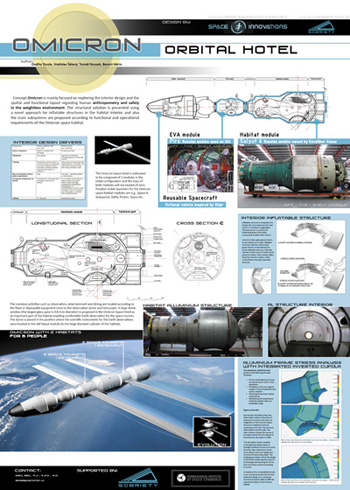
The design presented in this paper is in response to the revolution in private space activities, the increasing public interest in commercial flights to space and the utilization of structures such as space hotels or private orbital habitats. The baseline for the Omicron design concept is the Russian Salyut derived space station module. Salyut was the first space station to orbit the Earth. Its unique design and technical features were what made the development of space stations Salyut 1–7, MIR and the International Space Station (ISS) Zwezda service module possible. Due to its versatility and the reliable operating launch vehicle Proton, this space module series has the potential to be adapted for space hotel development. This paper proposes a conceptual design of the space habitat called Omicron, with particular focus on interior design for the microgravity environment. The Omicron concepts address the needs of space tourism with a strong emphasis on the safety and comfort of the spaceflight participants. The Omicron habitat supports three inhabitants in nominal conditions (e.g., two passengers and one astronaut). The habitat provides a flexible interior, facilities and spaces dynamically transforming in order to accommodate various types of activities, which will be performed in an organically formed interior supporting spatial orientation and movement in microgravity. The future development potential of Omicron is also considered. The baseline version is composed solely of one rigid module with an inverted cupola for observations. An alternative version offers more space using an inflatable structure. Finally, a combination of multiple Omicron modules enables the creation of a larger orbital habitat. The Omicron’s subsystems support a few days visit by trained passengers. The transport to the habitat would be provided e.g., by the Soyuz TMA spacecraft carried by the Soyuz launch vehicle in the early stage of Omicron’s development, before a fully reusable spacecraft would be available.
Copyright Space Innovations, v.o.s.