Advances in Engineering Advances in Engineering features breaking research judged by Advances in Engineering advisory team to be of key importance in the Engineering field. Papers are selected from over 10,000 published each week from most peer reviewed journals.

Priimagi A, Saccone M, Cavallo G, Shishido A, Pilati T, Metrangolo P, Resnati G.
Adv Mater. 2012 Nov 20;24(44):OP345-52.
Collaborative work between the following Laboratories:
Abstract
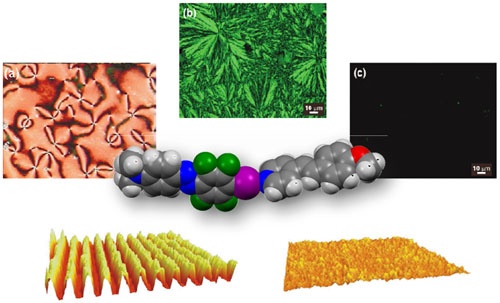
It is demonstrated that halogen bonding can be used to construct low-molecular-weight supramolecular complexes with unique light-responsive properties. In particular, halogen bonding drives the formation of a photoresponsive liquid-crystalline complex between a non-mesogenic halogen bond-donor molecule incorporating an azo group, and a non-mesogenic alkoxystilbazole moiety, acting as a halogen bond-acceptor. Upon irradiation with polarized light, the complex exhibits a high degree of photoinduced anisotropy (order parameter of molecular alignment > 0.5). Moreover, efficient photoinduced surface-relief-grating (SRG) formation occurs upon irradiation with a light interference pattern, with a surface-modulation depth 2.4 times the initial film thickness. This is the first report on a halogen-bonded photoresponsive low-molecular-weight complex, which furthermore combines a high degree of photoalignment and extremely efficient SRG formation in a unique way. This study highlights the potential of halogen bonding as a new tool for the rational design of high-performance photoresponsive suprastructures.
Copyright © 2012 WILEY-VCH Verlag GmbH & Co. KGaA, Weinheim.
Additional Information
Halogen bond is a rather exotic noncovalent interaction in the construction of supramolecular self-assemblies. It is said to be similar to the more familiar hydrogen bond, nevertheless it is the differences between these two interactions that open up new avenues for the design of innovative halogen-bond-based photoresponsive materials. Now, for the first time, researchers from Finland, Italy, and Japan have designed photoresponsive, halogen-bond-driven, liquid crystals. As reported in Advanced Materials ( DOI: 10.1002/adma.201204060), their material not only undergoes efficient photoalignment upon irradiation with polarized light, but more strikingly, thin films of the complex form surface-relief patterns with modulation depth exceeding the initial film thickness by a factor of 2.4 when irradiated with light interference pattern. The unique combination of efficient photoalignment and unprecedented mass-transport efficiency pinpoints halogen bonding as a new design tool for light-triggered, switchable supramolecular structures, with potential applications as, e.g., photocontrollable surfaces (for liquid-crystal alignment or non-wettability surfaces), and novel holographic-storage media.
Correspondence: [email protected]