Advances in Engineering Advances in Engineering features breaking research judged by Advances in Engineering advisory team to be of key importance in the Engineering field. Papers are selected from over 10,000 published each week from most peer reviewed journals.

ACS Appl. Mater. Interfaces, 2012, 4 (9), pp 4792–4799.
Seunghwa Yang , Joonmyung Choi , and Maenghyo Cho .
Division of WCU Multiscale Mechanical Design, School of Mechanical and Aerospace Engineering, Seoul National University 599, Kwanak-Ro, Kwanak-Ku, Seoul151-744, Korea.
Abstract
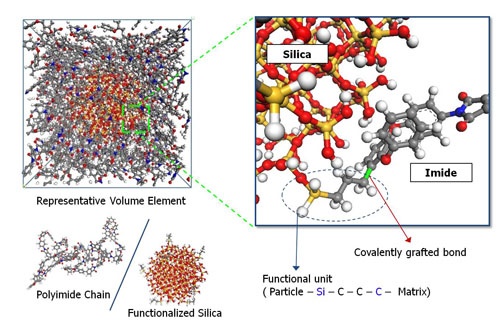
The filler size-dependent elastic stiffness of nanosilica ({Alpha}-quartz)-reinforced polyimide(s-BPDA/1,3,4-APB) composites under the same volume fraction and grafting ratio conditions was investigated via molecular dynamics(MD) simulations. To enhance the interfacial load transfer efficiency, we treated the surface oxygen atoms of the silica nanoparticle with additional silicon atoms attached by a propyl group to which the aromatic hydrocarbon in the polyimide is directly grafted. As the radius of the embedded nanoparticle increases, the Young’s and shear moduli gradually decrease, showing a prominent filler size effect. At the same time, the moduli of the nanocomposites increase as the grafting ratio increases. The contribution of different nanoparticles to the filler size dependency in elastic stiffness of the nanocomposites can be elucidated by comparing the normalized adhesive interaction energy between the particle and matrix which exhibits prominent filler size dependency. Because of the immobilization of the matrix polymer in the vicinity of the nanoparticles, which was confirmed by the self-diffusion coefficient, the highly grafted interface is found to bring about a greater reinforcing effect than the ungrafted interface.
Copyright © 2012 American Chemical Society
Additional Information:
Smart Structures and Design Lab at Seoul National University has made continuous efforts, through NRF Creative Research Initiative Program, in the multiscale simulation and design in the prediction of physical behaviors of nanocomposites. The effect of a surface treatment on the nanoparticle with functional group which gives structural and energetical stability on the interface between the particle and the matrix has been rarely attended in spite of its significant role to the mechanical characteristics of the nanocomposites. In this regard, the filler size dependency on the mechanical properties of the covalently grafted nanosilica reinforced polyimide composites was quantitatively characterized through the atomistic molecular dynamics simulation. Comparing with the ungrafted models, the grafted nanocomposites show higher Young’s and shear modulus while they maintain their filler size dependency. In addition, the nonbonding interaction energy between the filler and matrix decreases according to the nanoparticle radius which indicates that the total amount of nonbonding interaction pairs per unit volume is increased as the particle radius decreases. Furthermore, the self diffusion coefficient of densified polymer in the vicinity of the nanoparticle is significantly decreased as the covalent grafting ratio is increased because their covalent bonds act as anchor block to prevent the diffusion of the grafted polymer than the densified interphase region generated by particle-matrix nonbonding interactions. The findings of the present study can leave a lot of suggestions in equivalent continuum modeling and designing of nanocomposites with rigorous consideration of an interface treatment condition.