Advances in Engineering Advances in Engineering features breaking research judged by Advances in Engineering advisory team to be of key importance in the Engineering field. Papers are selected from over 10,000 published each week from most peer reviewed journals.

International Journal of Multiphase Flow, Volume 48, January 2013, Pages 1-10.
Sait Mekic, Benton Bakke
Department of Mechanical Engineering, North Dakota State University, 111 Dolve Hall, NDSU Dept. 2490, PO Box 6050, Fargo, ND 58102, United States
Abstract
A summary, new development on analytic solutions of models of the Darcy problem for liquid progression through porous media, and some experimental results obtained by these models are presented. Two anisotropic cases, 2D in-plane and 3D axisymetric transverse injection, are analyzed and compared with a reference case that is represented by the widely used closed-form solution of radial in-plane injection. The analytic solutions of the two analyzed models were originally interpreted as the approximate ones, since they were derived assuming that one component of pressure gradients, in the governing equations, may be neglected. It is shown that the assumption regarding pressure gradients in both cases may be released, that the original results present closed-form solutions of the imposed quasi-steady models, and through numerical experiments, that these models are not sensitive to the radius of the injection port within the range in which relevant parameters usually vary in experiments. With these findings and the results obtained experimentally, it is also show that the two models are equally accurate and reliable as the reference one. They can be employed for the evaluation of all three permeability tensor components utilizing a relatively simple apparatus and as such may be utilized as standard models.
Additional Information
Under the experimental conditions that are usually used in permeability tests of fibrous beds, analytical radial infusion models are mutually compatible and the results obtained by their applications are neither sensitive to the radius of the injection port, nor domains in which measurements of the flow front displacements are taken. They have relevant advantages in comparison with the parallel flow models: a) A relatively simple experimental setup can be used for accurate evaluation of all three permeability tensor components b) They are not susceptible to errors caused by the effects such as channeling c) Transverse permeability component can, practically, only be evaluated by these models. These advantages made them most suitable to be employed as standard models.
New development on analytic solutions of models of the Darcy problem for liquid progression through porous media, and some experimental results obtained by these models are presented. Two anisotropic cases, 2D in-plane and 3D axisymetric transverse injection, are analyzed and compared with a reference case that is represented by the widely used closed-form solution of radial in-plane injection. The analytic solutions of the two analyzed models were originally interpreted as the approximate ones, since they were derived assuming that one component of pressure gradients, in the governing equations, may be neglected. It is shown that the assumption regarding pressure gradients in both cases may be released, that the original results present closed-form solutions of the imposed quasi-steady models, and through numerical experiments, that these models are not sensitive to the radius of the injection port within the range in which relevant parameters usually vary in experiments. With these findings and the results obtained experimentally, it is also show that the two models are equally accurate and reliable as the reference one.
Figure Legend
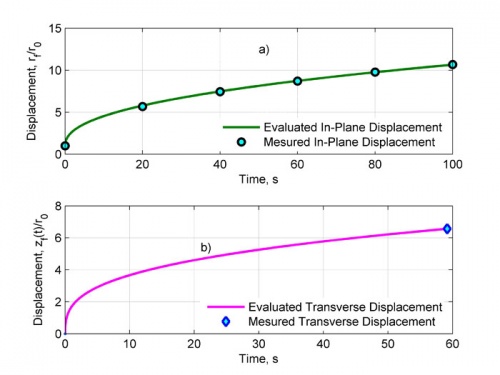
Measured and evaluated displacements in in-plane and transverse and permeability tests.