Advances in Engineering Advances in Engineering features breaking research judged by Advances in Engineering advisory team to be of key importance in the Engineering field. Papers are selected from over 10,000 published each week from most peer reviewed journals.

Agronomy Journal, May 9, 2012
R. M. Aiken, D. M. O’Brien, B. L. Olson, L. Murray
Northwest Kansas Research–Extension Center (NWREC), Kansas State Univ., P.O. Box 505, Colby, KS 67701
formerly with NWREC, currently with Monsanto Corp., Colby, KS 67701
Statistics Dep., Kansas State Univ., 101A Dickens Hall, Manhattan, KS 66506
Abstract
Water supply frequently limits crop yield in semiarid cropping systems; water deficits can restrict yields in drought-affected subhumid regions. In semiarid wheat (Triticum aestivumL.)-based cropping systems, replacing an uncropped fallow period with a crop can increase precipitation use efficiency but reduce wheat productivity. Our objective was to analyze crop sequence and environmental effects on water use, components of water productivity, and net returns of winter wheat (WW) in a semiarid region. A field study was established to evaluate eight 3-yr crop sequences, including a wheat phase followed by a feed grain phase (corn [Zea mays L.] or grain sorghum [Sorghum bicolor (L.) Moench]) and an oilseed phase (OS; spring canola [Brassica napus L.], soybean [Glycine max (L.) Merr.], sunflower [Helianthus annuus L.], or none [fallow]). Standard measurements included crop water use (WU), canopy leaf area index at anthesis, biomass, grain yield, and yield components. Net return (NR) was calculated as the difference between crop revenue and total operating costs. Replacing an uncropped fallow period with an OS crop reduced water productivity responses of WW (biomass, grain yield, and NR) by 18, 31, and 56%, respectively, relative to that of WW grown after fallow. These responses to continuous cropping corresponded to reductions in all components of a water-limiting yield production function. The modest water productivity observed (0.28–0.62 kg m−3), relative to a reported global range of 0.6 to 1.7 kg m−3, indicates opportunity to improve wheat water productivity through management and genetic gain.
Additional Information from the Authors:
Available soil water buffers water use and yield formation of winter wheat
Available soil water typically limits crop productivity in rain-fed semi-arid regions; and in drought-affected regions which are normally water-sufficient. Maximizing water-limited crop productivity typically requires management to minimize expected soil water deficits during critical yield formation stages such as floral and grain development.
Wheat growers in the semi-arid U.S. High Plains typically use an extended (11-month) fallow (non-cropped) period, permitting recharge of soil water reserves. Intensive cropping systems replace this fallow period with crops such as spring canola. Previous studies indicate that replacing fallow with a crop can increase use of precipitation; however, the wheat crop can suffer from reduced recharge of soil water. Our aim was to determine the relative importance of overall growth and grain formation processes in yield reduction of winter wheat, established after a fallow-replacement crop.
Winter wheat was grown in three-year crop sequences that included: a wheat phase; corn or grain sorghum following wheat; and either a fallow period or a fallow-replacement crop of spring canola, soybean or sunflower. Wheat water use was calculated from soil water depletion and precipitation during the growing season; wheat productivity was determined from above-ground biomass and components of grain yield. Wheat water productivity was evaluated as growth or yield responses to an additional increment of water use. Results, from 2002 through 2008 growing seasons, included effects of drought and normal growing conditions.
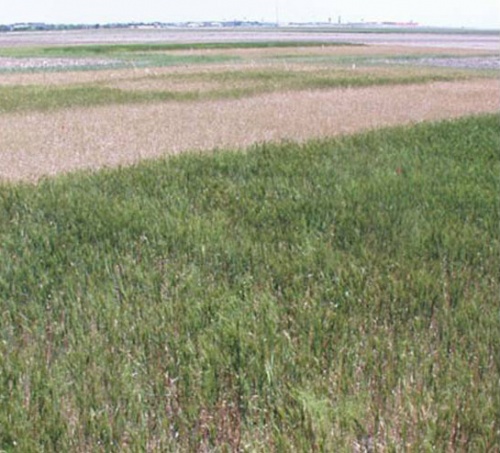
Water productivity was compared for wheat under continuous cropping (wheat following a fallow-replacement crop) to that of wheat following a fallow period. Continuous cropping reduced wheat biomass productivity, relative to water use, by 18%; reduced grain productivity, relative to water use, by 31%; and reduced net economic returns for the wheat crop, relative to water use, by 56%.
These results indicate that severe soil water deficits can impact grain yield formation to a greater extent than overall biomass productivity. When yield formation processes (e.g., floral development) are impaired, yield can be limited by sink strength (number of developing grains) as well as source strength (canopy productivity). Since drought effects include soil water deficits, these findings are expected to apply to crop productivity in drought-affected regions which are normally water-sufficient.
To the extent that climate change will increase heat and amplify weather cycles, drought conditions may occur with greater frequency and intensity—restricting crop water productivity. Incorporating stress tolerance traits into productive crop cultivars can enhance the resilience of cropping systems in the face of increased environmental variability.
Figure Legend
Winter wheat grown after an 11-month, fallow period (foreground) maintained yield-formation despite drought conditions in 2006 in western Kansas. In contrast, yield-formation failed for wheat grown in water-depleted soil (mid-ground), where a crop replaced the fallow period. Photo courtesy of Rob Aiken.