Advances in Engineering Advances in Engineering features breaking research judged by Advances in Engineering advisory team to be of key importance in the Engineering field. Papers are selected from over 10,000 published each week from most peer reviewed journals.

Powder Technology, Volume 241, June 2013, Pages 252-262.
Loreana Gallo, Juliana Pina, Verónica Bucalá, Daniel Allemandi, María Verónica Ramírez-Rigo.
Department of Pharmacy, Facultad de Ciencias Químicas, Universidad Nacional de Córdoba, CONICET, Edificio de Ciencias II, Ciudad Universitaria, (5000) Córdoba, Argentina and
Department of Chemical Engineering, PLAPIQUI, Universidad Nacional del Sur, CONICET, Camino La Carrindanga Km. 7, (8000) Bahía Blanca, Argentina.
Abstract
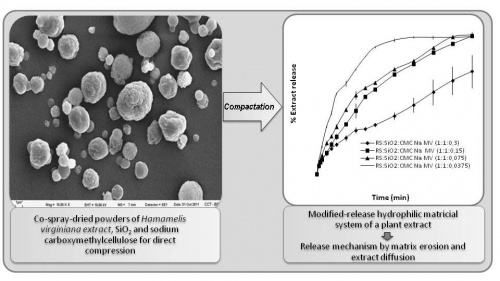
The aim of the work “Development of a modified-release hydrophilic matrix system of a plant extract based on co-spray-dried powders” by Loreana Gallo, Juliana Piña, Verónica Bucalá, Daniel Allemandi and María Verónica Ramírez-Rigo published in Powder Technology, 241, 252–262 , (2013) was to develop a modified-release solid dosage form comprising a plant extract. Due to its widespread use in the treatment of chronic varicose vein disease, Hamamelis virginiana was selected as a model plant extract and co-spray-dried with a hydrophilic polymer (sodium carboxymethylcellulose, Na-CMC) and a drying adjuvant (colloidal silicon dioxide, SiO2) The polymer was incorporated to modulate the drug release, and its selection was based on a screening of different common natural and semi-synthetic polymers. The drying adjuvant was added to improve the powder flowability, compressibility and compactability, which are key properties in the production of powders for direct compression (DC).
The influence of the Na-CMC viscosity (ultra high, high and medium viscosity grade) and concentration (plant extract solid residue:SiO2:Na-CMC ratio: 1:1:0.3, 1:1:0.15, 1:1:0.075 and 1:1:0.0375) on the product quality and process performance was studied. The use of medium viscosity (MV) Na-CMC led to high process yields and satisfactory product flow properties and moisture contents. The polymer concentration was the principal factor affecting the extract release rate. The product containing a plant extract solid residue:SiO2:Na-CMC MV ratio of 1:1:0.075 was the best formulation in terms of powder flowability, compactability and stability and the extract release properties. A combination of both extract diffusion and matrix erosion controlled the release rate.
The scalable co-spray-drying approach is suitable for improving the functionality of medicinal plant extract powders based on adequately designed formulations.