Advances in Engineering Advances in Engineering features breaking research judged by Advances in Engineering advisory team to be of key importance in the Engineering field. Papers are selected from over 10,000 published each week from most peer reviewed journals.

Anal Chem. 2013 Feb 5;85(3):1615-23.
Mishra S, Ghosh S, Mukhopadhyay R.
Department of Biological Chemistry, Indian Association for the Cultivation of Science, Jadavpur, Kolkata-700032, India.
Abstract
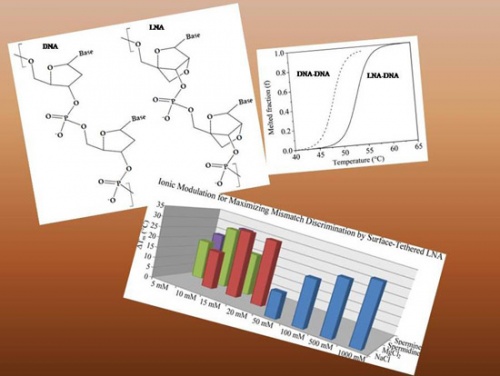
Several investigations on DNA-based nucleic acid sensors performed in the past few years point toward the requirement of an alternative nucleic acid that can detect target DNA strands more efficiently, i.e., with higher sensitivity and selectivity, and can be more robust compared to the DNA sensor probes. Locked nucleic acid (LNA), a conformationally restricted DNA analogue, is potentially a better alternative than DNA, since it is nuclease-resistant, it can form a more stable duplex with DNA in a sequence-specific manner, and it interacts less with substrate surface due to presence of a rigid backbone. In this work, we probed solid-phase dehybridization of ssDNA targets from densely packed fully modified ssLNA probes immobilized onto a gold(111) surface by fluorescence-based measurement of the “on-surface” melting temperatures. We find that mismatch discrimination can be clearly improved by applying the surface-tethered LNA probes, in comparison to the corresponding DNA probes. We show that concentration as well as type of cation (monovalent and polyvalent) can significantly influence thermal stability of the surface-confined LNA-DNA duplexes, the nature of concentration dependence contradicting the solution phase behavior. Since the ionic setting influenced the fully matched duplexes more strongly than the singly mismatched duplexes, the mismatch discrimination ability of the surface-confined LNA probes could be controlled by ionic modulations. To our knowledge, this is the first report on ionic regulation of melting behavior of surface-confined LNA-DNA duplexes.
Additional Information
Gene-sensors show great promise as tools for various applications, such as clinical diagnosis, forensic analysis and environmental monitoring. All microarray-based strategies that are applied in analysis of DNA/RNA variations are based directly or indirectly on the detection of hybridization of complementary DNA/RNA target strands from solution to the surface- immobilized nucleic acid capture probes. There have been several reports on DNA sensors that are based on ‘on-surface’ DNA-DNA hybridization. Though DNA-based sensors have found wide applications in the microscale as well as nanoscale nucleic acid sensing experiments, its reduced bioactivity due to non-specific DNA-surface interactions through relatively exposed nucleobases, lack of reproducibility and degradability by the nuclease, point towards the requirement of an alternative, so that, these drawbacks can be overcome.
Locked nucleic acid (LNA), a conformationally restricted DNA analogue, is potentially a better alternative than DNA, since it is nuclease-resistant, it can form a more stable duplex with DNA in a sequence-specific manner, and it interacts less with substrate surface due to presence of a rigid backbone. For surface-based sensor applications, we have formed a 2-dimensionally ordered LNA structure on gold(111) surface, which is capable of giving rise to 4-4.5 times stronger target DNA recognition signal with two times better single base mismatch discrimination compared to its DNA counterpart. As unambiguous identification of single base mismatch in DNA sequences is of great importance for understanding genetic variations present among individuals; to know how the individuals develop response to external agents like drugs, pathogens, chemicals etc.; and to recognize an individual’s propensity toward development of a specific disease, we further aimed at maximizing the single base mismatch discrimination capability of the self-assembled LNA film. We investigated the effects of varying concentrations of monovalent and polyvalent cations, namely Na+, Mg2+, spermidine (3+), and spermine (4+) on the hybridization of fully matched and singly mismatched DNA targets to the densely packed immobilized LNA probes by fluorescence-based measurement of the ‘on-surface’ melting temperatures. Generally it was observed that with increase in salt concentration mismatch discrimination ability of the LNA sensor layer could be increased, which is contradictory to the solution-phase behavior. The bivalent cation Mg2+ was found to be more efficient in mismatch discrimination compared to the monovalent sodium as well as the trivalent spermidine and tetravalent spermine. It can therefore be concluded that the mismatch discrimination ability of surface-anchored LNA probes can be maximized by simple ionic adjustments.