Advances in Engineering Advances in Engineering features breaking research judged by Advances in Engineering advisory team to be of key importance in the Engineering field. Papers are selected from over 10,000 published each week from most peer reviewed journals.

Chemical Engineering Science, Volume 87, 14 January 2013, Pages 23-39.
Benny T. Kuan, Peter J. Witt.
Division of Mathematics, Informatics and Statistics, CSIRO, Box 312, Clayton South, VIC 3169, Australia.
Abstract
Supersonic quenching of magnesium vapour plays a pivotal role in the carbothermal reduction process for magnesium and the production of fine magnesium powders. Modelling of this process has previously been based on Classical Nucleation Theory in a one-dimensional flow expansion without considerations of background gas turbulence and the associated heat and mass transfers. This paper presents a single-velocity field, multi-component fluid model that overcomes the above shortcomings. The model has been validated using steam condensation data and applied to study supersonic quenching of magnesium vapour in a laboratory-scale Laval nozzle. Modelling results indicate a strong dependence of the vapour condensation characteristics on parameters such as vapour concentration and choice of carrier gas. The model is potentially a useful tool for designing and up-scaling processes that utilise supersonic quenching of metallic vapours.
Additional Information
Magnesium is the lightest of the structural metals and is useful for a wide range of industrial applications. Carbothermal production has been recognized as conceptually the simplest and cleanest route to magnesium metal, but has suffered from technical challenges of development and scale-up. The well-known primary issue with the carbothermal process is reversion – the reaction proceeds in the reverse direction very easily; this can be minimized by cooling the gaseous reaction products very rapidly.
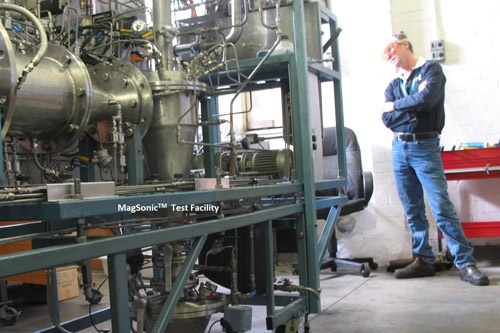
Work by CSIRO (Commonwealth Scientific and Industrial Research Organisation) in Australia has now successfully demonstrated the technology using supersonic quenching of magnesium vapor (the MagSonicTM Process). The reaction products (gases) are accelerated to several times the speed of sound (typically Ma ≈ 4-5), achieving very rapid gas cooling. Key barriers to process development have been overcome: the experimental program has achieved sustained operation, no nozzle blockage, minimal reversion, and safe handling of pyrophoric powders. The laboratory equipment has been operated at industrially relevant magnesium vapor concentrations (>25% Mg) for multiple runs with no blockage. Novel computational fluid dynamics (CFD) modeling of the shock quenching and metal vapor condensation has informed nozzle design and is supported by experimental data. Reversion below 10% has been demonstrated, and magnesium successfully purified (>99.9%) from the collected powder. Safe operating procedures have been developed and demonstrated, minimizing the risk of powder explosion. The MagSonicTM process is now ready to progress to significantly larger scale and continuous operation.