Advances in Engineering Advances in Engineering features breaking research judged by Advances in Engineering advisory team to be of key importance in the Engineering field. Papers are selected from over 10,000 published each week from most peer reviewed journals.

Journal of Applied Polymer Science, Volume 129, Issue 1, pages 121–129, 5 July 2013.
Vijaya K. Rangari, Ghouse M. Mohammad, Boyoglu, Seyhan, Shaik Jeelani.
Department of Materials Science and Engineering, Tuskegee University, Tuskegee, Alabama 36088 and
Center for NanoBiotechnology Research, Alabama State University, Montgomery, Alabama.
Abstract
In this investigation, in situ synthesis of zinc oxide nanoparticles in the presence of multiwalled carbon nanotubes (CNTs) have been carried out using a sonochemical technique. Zinc(II)acetate was used as a source of ZnO in the presence of ethylene glycol (EG) to obtain zinc oxide (ZnO) nanoparticles. The synthesized hybrid ZnO/CNTs nanoparticles were used as reinforcements to enhance the mechanical, thermal and UV absorbing properties of Nylon-6 composite fibers. The polymer nanocomposites (PNC) were fabricated by dry mixing Nylon-6 polymer powder with the ZnO/CNTs hybrid nanoparticles as the first step, then followed by the drying and melt extrusion process of fiber materials in a single-screw extruder. The extruded fibers were stretched and stabilized using a godet set-up and wound on a Wayne filament winder machine. The hybrid ZnO/CNTs infused Nylon-6 composite fibers were compared with commercial ZnO, CNTs infused Nylon-6 composite fibers and neat Nylon-6 fibers for their structural and thermal properties. The morphological characteristics of ZnO/CNTs nanoparticles were carried out using X-ray diffraction and transmission electron microscopy (TEM) techniques. The Nylon-6 PNC fibers which were of ∼80 u size were tested mechanically. The tensile tests revealed that failure stress of the 1% infused ZnO/CNTs Nylon-6 PNC fibers is about 73% higher than the neat extruded Nylon-6 fiber and the improvement in the tensile modulus is 377.4%. The DSC results show an increase in the glass transition temperature and crystallization for ZnO/CNTs infused Nylon-6 PNC fibers. © 2012 Wiley Periodicals, Inc. J. Appl. Polym. Sci., 2013.
Copyright © 2012 Wiley Periodicals, Inc.
Additional Information
Dr.Rangari and his research group have developed a method to decorate the metal, metal oxide and metal carbide nanoparticles on acicular nanoparticles such as carbon nanotubes and silicon nitride nanorods for various applications including fillers for polymers. These hybride nanoparticles were further aligned in nylon-6 polymer single fiber through the melt extrusion process for high tensile strength, conducting, antimicrobial, and UV- absorbing textile application.
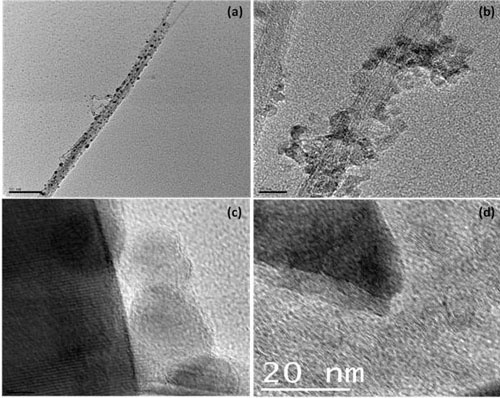
Figure: TEM micrograph of a) Ag /CNTs, b)Dimond/CNTs, c) Si3N4/SiC and d)ZnO/CNTs