Advances in Engineering Advances in Engineering features breaking research judged by Advances in Engineering advisory team to be of key importance in the Engineering field. Papers are selected from over 10,000 published each week from most peer reviewed journals.

Acta Materialia, Volume 61, Issue 14, 2013, Pages 5365-5374.
Neda Dalili, Qi Liu, Douglas G. Ivey.
Department of Chemical and Materials Engineering, University of Alberta, Edmonton, AB T6G 2V4, Canada.
Abstract
Thermodynamic calculations were carried out to derive the Gibbs free energy diagram for the amorphous and crystalline phases in the Ta–Rh system. These calculations predicted that the compositional range for the amorphous Ta–Rh phase was within 37–66 at.% Ta, which was validated by X-ray diffraction (XRD) analysis, high-resolution transmission electron microscopy (HRTEM) observations and resistivity measurements of as-deposited films. The thermodynamic modeling provided a valuable guide for selecting an amorphous composition suitable for diffusion barrier applications. The stability and metallurgical failure mechanism for TaRhx diffusion barriers in contact with Cu and/or Si were investigated by resistivity measurements, XRD analysis and detailed electron microscopy on samples annealed in 5% H2/95% N2 gas for 30 min at various temperatures. Amorphous TaRhx in contact with the Si substrate was stable up to 700 °C, whereupon TaRhxdecomposed and reacted to form TaSi2 and RhSi. Si/amorphousTaRhx (13 nm)/Cu stacks, on the other hand, were stable only up to 550 °C. Failure occurred by reaction of Rh with the Si substrate to form RhSi at the interface. The large density of defects formed in the barrier layer as a result of outward diffusion of Rh facilitated diffusion of Cu to the Si/TaRhx interface to form Cu3Si particles. The formation of Cu3Si was observed to trigger further silicidation of the barrier to form a discontinuous TaSi2 layer.
Additional Information
The incorporation of Cu interconnects into the manufacturing of integrated circuits has resulted in several modifications to the fabrication process (e.g., the development of the dual damascene process) and the associated material systems (e.g., diffusion barriers). The development of diffusion barrier materials imposes a critical challenge, as Cu is a fast diffuser in Si and the adjacent dielectric layers, which can result in device deterioration and failure. Technology development is driven mainly by continuous feature size scaling; thus, the diffusion barrier must be able to perform satisfactorily at continuously reducing thicknesses. Conventional barriers used for Cu interconnects are TaNx based films, which require the deposition of an additional Cu seed layer by electrochemical deposition prior to filling of the interconnects. As feature sizes decrease, there has been considerable interest in developing diffusion barriers that are amenable to direct electrodeposition of Cu without the need for a seed layer. However, there is a need for a suitable guide for selecting material systems suitable for diffusion barrier applications.
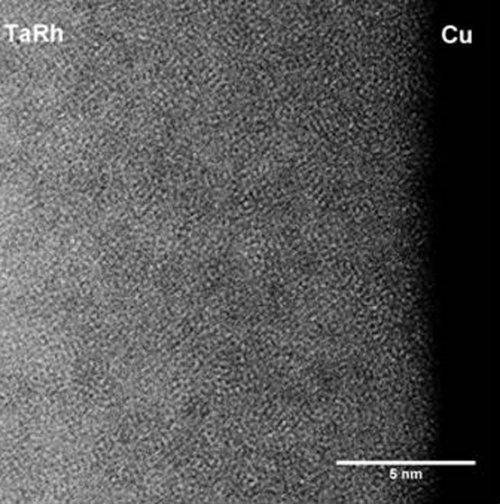
In this work, a systematic approach was adopted to select an amorphous, low resistivity diffusion barrier material with the possibility of direct electrodeposition of Cu. After comprehensive consideration of possible alloys, the Ta-Rh system was selected as the candidate barrier. Thermodynamic calculations were performed to select the most stable amorphous composition in the system and these were verified by detailed structural characterization. The performance of the selected TaRhx alloy as a diffusion barrier was evaluated by metallurgical and electrical characterization. Metallurgical characterization was performed by in-situ and ex-situ annealing experiments on Si/diffusion barrier/Cu stacks (Figure 1). The results of the ex-situ heating experiments are published elsewhere (N. Dalili, P. Li, M. Kupsta, Q. Liu, D.G. Ivey, Micron, DOI: 10.1016/j.micron.2013.11.002). Additionally, the performance of the selected alloys was evaluated by electrical characterization, by monitoring the capacitance-voltage characteristics of metal oxide semiconductor capacitors after bias temperature stress testing. The results of this latter study are also published (N. Dalili, D.G. Ivey, Journal of Materials Science: Materials in Electronics, DOI: 10.1007/s10854-013-1662-8). The material selection process presented in this study, based on thermodynamic modeling, provides a great tool for evaluating new material systems and selecting a composition appropriate for diffusion barrier applications.
Figure Legend
TEM cross section image of Ta-Rh diffusion barrier on Si substrate with Cu overlayer. (Image courtesy of Mr. Akira Yasuhara, TEM Applications Group, JEOL Ltd.)