Advances in Engineering Advances in Engineering features breaking research judged by Advances in Engineering advisory team to be of key importance in the Engineering field. Papers are selected from over 10,000 published each week from most peer reviewed journals.

Journal of Catalysis, Volume 321, Jan 2015, Pages 23–31.
Rachit Khare1, Dean Millar2, Aditya Bhan1
- Department of Chemical Engineering and Materials Science, University of Minnesota – Twin Cities, 421 Washington Avenue SE, Minneapolis, MN 55455, USA and
- Core R&D, The Dow Chemical Company, 1776 Building, Midland, MI 48674, USA
Abstract
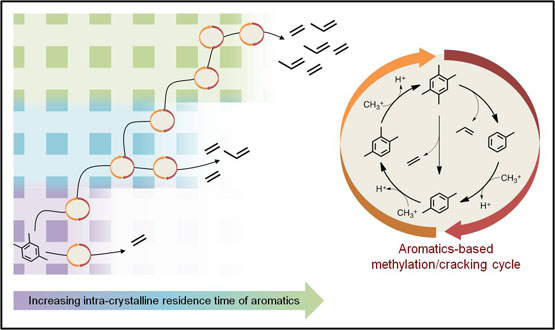
Light olefin selectivity in methanol-to-hydrocarbons conversion on MFI increases with an increase in crystallite size because intra-crystalline residence time of methylbenzenes increases as a consequence of increased transport restrictions, which enables these methylbenzenes to undergo multiple methylation/dealkylation reactions before exiting the crystal. Selectivity toward light olefins, for the reaction of dimethyl ether (DME) at 623 K, increased monotonically from 22% in 2 nm-MFI (∼2 nm crystallites) to 47% in 17 μm-MFI (∼17 μm crystallites) at 46–59% net DME conversion. Transport restrictions were introduced externally in a conventional MFI sample (500 nm-MFI) by single-/multi-cycle silylation using tetraethyl orthosilicate. Light olefin selectivity, for the reaction of DME at 623 K and at 46–59% net DME conversion, increased from 33% in the conventional MFI sample to 49% in a sample that had undergone three silylation treatments. Adsorption uptake measurements of 2,2-dimethylbutane were used to estimate the “effective” crystallite size of the silylated MFI samples. Total light olefin selectivity and ethene/(2-methyl-2-butene + 2-methylbutane) increased monotonically with the effective crystallite size for all zeolite samples used in this study, irrespective of their provenance, thereby suggesting that the mechanistic basis for increase in light olefin selectivity with increasing crystallite size is the enhanced propagation of aromatics-based catalytic cycle.