 Advances in Engineering Advances in Engineering features breaking research judged by Advances in Engineering advisory team to be of key importance in the Engineering field. Papers are selected from over 10,000 published each week from most peer reviewed journals.

Significance statement
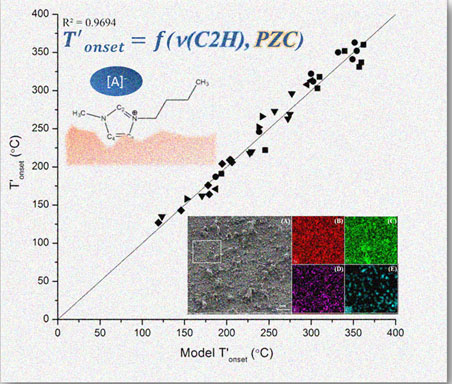
Immobilization of ionic liquids (ILs) on metal-oxides is becoming a common way of utilizing ILs for various applications. Thermal stability limits determined for bulk ILs is not sufficient to set the maximum operating conditions of these applications. Because, there are interactions between ILs and metal-oxides and these interactions might alter the stability limits significantly. Here, we have investigated the stability limits of metal-oxide-supported ILs with 1-n-butyl-3-methylimidazolium cation, [BMIM]+, on most commonly used metal-oxides, SiO2, TiO2, γ-Al2O3 and MgO. Data show that the stability limits of bulk and metal-oxide-supported ILs linearly increase with increasing acidity of C2 proton on imidazolium ring, controlling the inter-ionic interaction strength. The presence of metal-oxide lowers the stability limits. As the surface acidity decreases the interaction between IL and metal-oxide becomes the dominant factor. Based on these findings a simple mathematical expression was developed as a function of PZC and inter-ionic interaction strength probed by ν(C2H) to estimate the stability limits of 1-n-butyl-3-methylimidazolium cation-based ILs supported on metal-oxides. Performance of the model was tested on several different ILs supported on different metal-oxides, including Fe2O3 and CeO2. Results show that the model successfully estimates the maximum operating temperatures with an average relative error of less than 4.3 %. We suggest that the model developed here can help to choose proper ILs which can tolerate the operating conditions of systems including ILs immobilized on metal-oxides, such as in solid catalysts with ionic liquid layer (SCILL) or in supported ionic liquid phase (SILP) catalysts.
Figure Legend: simple model estimates the maximum tolerable temperatures of ionic liquids on metal-oxides as a function of (C2H) acidity of the imidazolium cation and the point of zero charge of the metal-oxide. (figure permission from the publisher was obtained, Chemical Engineering Science, Volume 123, 2015, Pages 588-595.)
Journal Reference
Chemical Engineering Science, Volume 123, 2015, Pages 588-595. Aslı Akçay1,2, Melike Babucci1,2, Volkan Balci1,2, Alper Uzun1,2
- Department of Chemical and Biological Engineering, Koç University, Rumelifeneri Yolu, Sariyer 34450, Istanbul, Turkey.
- Koç University TÜPRAŞ Energy Center (KUTEM), Koç University, Rumelifeneri Yolu, Sariyer 34450, Istanbul, Turkey.
Abstract
The thermal stability limits of metal-oxide-supported ionic liquids (ILs) with 1-n-butyl-3-methylimidazolium cation, [BMIM]+, on most commonly used metal-oxides, SiO2, TiO2, γ-Al2O3, and MgO are determined. Data show that stability limits of bulk and metal-oxide-supported ILs linearly increase with increasing acidity of C2 proton on imidazolium ring, controlling the inter-ionic interaction strength. Moreover, data also show that the presence of metal-oxide lowers the stability limits considerably. This effect becomes more significant as the surface acidity of the metal-oxide decreases from SiO2 to MgO. This decrease in stability limits with increasing point of zero charge (PZC) of metal-oxide indicates that the interaction between IL and metal-oxide becomes the dominant factor rather than the inter-ionic interactions. Based on these findings a simple mathematical expression was developed as a function of PZC and inter-ionic interaction strength probed by ν(C2H) to predict the stability limits of [BMIM]+-based ILs immobilized on metal-oxides. Performance of the model was tested on several different ILs supported on different metal-oxides, including Fe2O3 and CeO2. Results show that the model successfully predicts the maximum operating or tolerable temperatures of supported-[BMIM]+-based ILs with an average relative error less than 4.3%. We suggest that the model developed here can help to choose proper ILs that can tolerate the operating conditions of systems including ILs immobilized on metal-oxides, such as in solid catalysts with ionic liquid layer (SCILL) or in supported ionic liquid phase (SILP) catalysts.
Go To Chemical Engineering Science
