Advances in Engineering Advances in Engineering features breaking research judged by Advances in Engineering advisory team to be of key importance in the Engineering field. Papers are selected from over 10,000 published each week from most peer reviewed journals.

Significance Statement
Among the gases present in NOx, nitrogen dioxide (NO2) is one of the most dangerous. It causes a range of harmful effects on the lungs such as increased inflammation of the airways, worsened cough and wheezing, reduced lung function, increased asthma attacks and increased susceptibility to respiratory infection. All these problems are more important for children and older adults. Due to the ubiquitous presence of this gas the developing of selective and sensitive sensing methods is a hot area of research
Traditionally electrochemical sensors are usually used for detection of NO2 in real labor environments, however interference from coexisting gases have been reported to be a problem in these devices. Moreover recent alternative approaches for detecting NO2 such as laser-based photoacoustic spectroscopy, surface acoustic wave (SAW), transition metal oxide devices carbon quantum dot-functionalized aerogels, or ozone treated graphene have been reported.
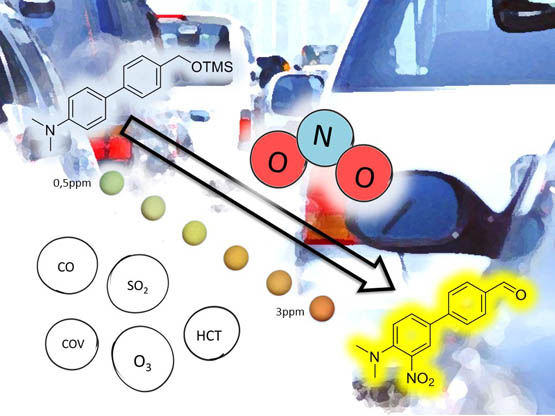
In this paper, we report the use of a reliable, easy to use, cheap and selective chromogenic probe for detecting NO2 both in solution an in the gas phase. The probe has two different measurement channels: change of colour (naked-eye detection) and fluorescence (naked eye detection upon irradiation with a conventional 254 nm UV lamp). The limit of detection is 0.1 ppm with a time of response of 5 minutes. Films containing the probe have been tested in real conditions in a traffic tunnel in Valencia (Spain) with good results. The probe selectivity was evaluated in front of the most common pullulan gases such as NO, H2S, CO or SO2.
Journal Reference
Chemistry. 2015 Jun 8;21(24):8720-2.
Juárez LA1,2, Costero AM3,4, Sancenón F1,5,6, Martínez-Máñez R1,5,6, Parra M1,2, Gaviña P1,2.
[expand title=”Show Affiliations”]- Centro de Reconocimiento Molecular y Desarrollo Tecnológico (IDM), Unidad Mixta Universidad Politécnica de Valencia, Universidad de Valencia (Spain).
- Departamento de Química orgánica, Universidad de Valencia, Doctor Moliner 50, 46100, Burjassot, Valencia (Spain).
- Centro de Reconocimiento Molecular y Desarrollo Tecnológico (IDM), Unidad Mixta Universidad Politécnica de Valencia, Universidad de Valencia (Spain). [email protected].
- Departamento de Química orgánica, Universidad de Valencia, Doctor Moliner 50, 46100, Burjassot, Valencia (Spain). [email protected].
- Departamento de Química, Universidad Politécnica de Valencia, Camino de Vera s/n, 46022-Valencia (Spain).
- CIBER de Bioingeniería, Biomateriales y Nanomedicina (CIBER-BBN).
Abstract
A new chromo-fluorogenic probe, consisting of a biphenyl derivative containing both a silylbenzyl ether and a N,N-dimethylamino group, for NO2 detection in the gas phase has been developed. A clear colour change from colourless to yellow together with an emission quenching was observed when the probe reacted with NO2 . A limit of detection to the naked eye of about 0.1 ppm was determined and the system was successfully applied to the detection of NO2 in realistic atmospheric conditions.
© 2015 WILEY-VCH Verlag GmbH & Co. KGaA, Weinheim.
Go To Chemistry
About the Authors
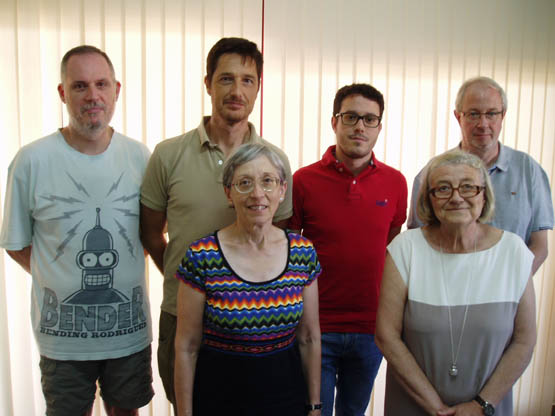
The authors belong to the Institute of Molecular Recognition and Technologic Development (IDM). This Institute is a research center dependent on both the Universitat de València and the Universitat Politècnica de València. The research group has been working in the last years in the development of chromogenic and/or fluorogenic sensors or chemodosimeter for different dangerous gases. In that sense, the group has reported selective probes for detecting nerve agent mimics for both G-series and V-series compounds, HCN, H2S or NO. They are aslo interested in pesticide detection and remediation. The prepared sensors have been supported on solid supports to make them easier to be used. Continuous detection can be registered and stored by using a simple device and a personal computer.