Advances in Engineering Advances in Engineering features breaking research judged by Advances in Engineering advisory team to be of key importance in the Engineering field. Papers are selected from over 10,000 published each week from most peer reviewed journals.

Biosensors and Bioelectronics, Volume 40, Issue 1, 15 February 2013, Pages 283-290.
Ajay Kumar Yagati, Taek Lee, Junhong Min, Jeong-Woo Choi.
Interdisciplinary Program of Integrated Biotechnology, Sogang University, Seoul 121-742, Korea and
Department of Chemical and Biomolecular Engineering, Sogang University, 35 Baekbeom-ro (Sinsu-dong), Mapo-gu, Seoul 121-742, Korea and
School of Integrative Engineering, Chung-Ang University, Heukseok-dong, Dongjak-gu, Seoul 156-756, Republic of Korea.
Abstract
We developed a nanoscale memory device consisting of signal-responsive biomaterial, which is capable of switching physical properties (such as electrical/electrochemical, optical, and magnetic) upon application of appropriate electrical signals to perform memory switching. Here, we propose a highly robust surface-confined switch composed of an electroactive cysteine-modified azurin immobilized on an Au hexagonal pattern formed on indium tin oxide (ITO) substrates that can be controlled electrochemically and reversibly converted between its redox states. The memory effect is based on conductance switching, which leads to the occurrence of bistable states and behaves as an extremely robust redox switch in which an electrochemical input is transduced into optical and magnetic outputs under ambient conditions. The fact that this molecular surface switch, operating at very low voltages, can be patterned and addressed locally, and also has good stability and excellent reversibility, makes it a promising platform for nonvolatile memory devices.
Additional information
There has been a great interest in the development of bioelectronic devices which performs the computations similar to the current silicon based semiconductor devices due to their intrinsic properties and functions. Biomolecules with particular functionality and self-assembling capabilitiescan be exploited for the implementation of functional devices like biotransistor, memristor and other bioelectronicdevices. The main principle behind the development of such kind of devices was inspired from the naturally occurring electron transport phenomena that exist in the biological systems. Therefore, by utilizing the functional properties of biomolecules, an efficient biodevices can be developed. The current research is focused on the development of a nanoscale memory device, consisting of cysteine substituted azurin as an active component on gold nanodots. Functional azurin proteins developed in this study were covalently-immobilized on Au electrode array patterned on a single ITO substrate. The redox property of the azurin protein was used to depict the memory device characteristics, such as write and erase functions. The redox property of azurin molecules on individual electrodes was measured by cyclic voltammetry (CV). Chronoamperometry (CA) method was utilized to confirm the memory function of the fabricated biodevice. Upon applying oxidation voltage to Au electrode causes the protein layer becomes oxidized and stores positive charge which is represented as memory write (bit of “1”) and on contrary with the reduction voltage the protein molecules will retain its original state (bit of “0”). Further the optical and magnetic properties of both oxidized and reduced forms of azurin protein were analyzed to make use as output for memory performance. Applying redox potentials in different combinations a bit of information can be stored in to the azurin molecules on the patterned Au dots. Finally, based on the measurements of the charging currents of the fabricated biomemory device, it is likely to be the key in the development of molecular/semiconductor electronic devices.
Acknowledgments: This research was supported by the National Research Foundation of Korea (NRF) grant funded by the Ministry of Science, ICT & Future Planning (2005-2001333). This work was supported by the National Research Foundation of Korea (NRF) grant funded by the Korea government (MSIP) (2009-0080860).
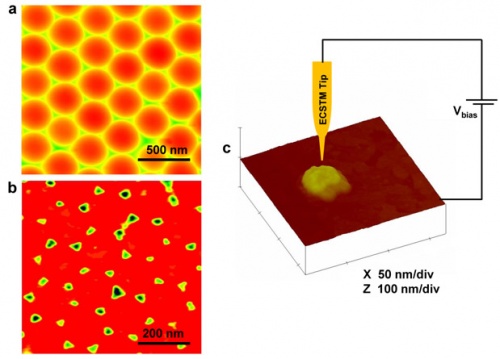
Figure 1: Scanning tunneling microscopic images of (a) polystyrene particles spin coated on ITO surface (b) resulting Au pattern obtained by Nanosphere lithography (c) Experimental method to develop nanoscale biomemory device by conductance measurements of single molecule adsorbed on au dot.