Advances in Engineering Advances in Engineering features breaking research judged by Advances in Engineering advisory team to be of key importance in the Engineering field. Papers are selected from over 10,000 published each week from most peer reviewed journals.

Angew Chem Int Ed Engl. 2012 Aug 20;51(34):8577-80.
Protti S, Ravelli D, Mannucci B, Albini A, Fagnoni M.
PhotoGreen Lab, Department of Chemistry, University of Pavia, V Le Taramelli 12, 27100 Pavia, Italy.
Abstract
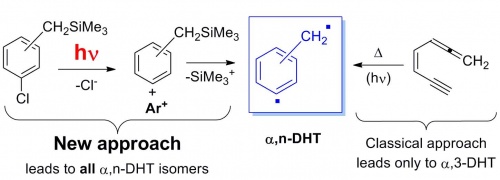
Doubly radical: A novel entry to {Alpha},n-didehydrotoluene (DHT) diradicals is disclosed and proceeds through the photochemical activation of (chlorobenzyl)trimethylsilanes with chloride loss and elimination of the SiMe(3) (+) group. The products formed in solution are indicative of the intermediacy of the three isomers of the {Alpha},n-DHT.
Copyright © 2012 WILEY-VCH Verlag GmbH & Co. KGaA, Weinheim.
Additional Information
The key issue with anti cancer agents is selectivity. A relatively new class of anticancer agents that have gained more and more attention since their discovery in the mid-1980s is that of natural enyne antibiotics, indeed among the most effective chemotherapeutic agents known. It is important to recognize that with these compounds the generation of the active form, a high energy intermediate (a biradical), is made thermodynamically possible by the simultaneous acquiring of the aromatic stabilization. Typical examples are the Bergman rearrangement of enediynes, typical of Dynemicin or related compounds, and the Myers-Saito rearrangement of enyne-allenes, found in Neocarzinostatin (NCS). In the Myers-Saito reaction, ,3-didehydrotoluenes (,3-DHT, a ,-biradical; see Scheme) are invoked as the reactive intermediates and these are the only isomers that have been generated in solution up to now. The alternative approach we developed involves the photochemical reaction of an aromatic derivative (typically an electron-rich aryl chloride) that induces two consecutive elimination steps by absorption of a photon. Thus, photolysis of the three isomeric (chlorobenzyl)trimethylsilanes in alcohols or in mixed aqueous solutions generated the corresponding didehydrotoluenes (,n-DHTs) by chloride anion and trimethylsilyl cation loss via a phenyl cation (Ar+) intermediate. Contrary to the Myers-Saito cyclization, wherein the two radical centers are formed simultaneously, in the present approach the radical centers are formed sequentially.
Indeed, this straightforward generation of didehydrotoluene intermediates overcomes the shortcomings of the so far developed cycloaromatization of enyne-allenes, which is limited to the generation of the ,3-DHT isomer, and opens the path for understanding the chemistry (and possibly the biological action) of these unusual intermediates. Another advantage of the present approach is the photochemical mode of activation that allows the spatial and temporal control of the reaction.
This work is part of the ongoing project “Antitumorals: photochemistry beyond enynes” assigned by Fondazione Cariplo (Grant No. 2011-1839).