Advances in Engineering Advances in Engineering features breaking research judged by Advances in Engineering advisory team to be of key importance in the Engineering field. Papers are selected from over 10,000 published each week from most peer reviewed journals.

Anal Bioanal Chem. 2013 Jan;405(2-3):1067-75.
Bianchi F, Basini G, Grolli S, Conti V, Bianchi F, Grasselli F, Careri M, Ramoni R.
Dipartimento di Chimica, Università degli Studi di Parma, Parma, Italy. [email protected].
Abstract
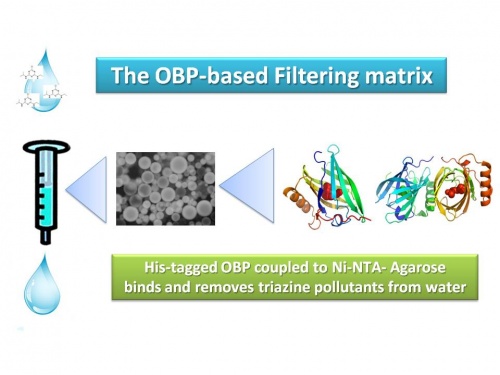
Odorant binding protein (OBP) is a multi-functional scavenger for small hydrophobic molecules dissolved in the mucus lining the nasal epithelia of mammals, characterized by broad ligand binding specificity towards a large number of structurally unrelated natural and synthetic molecules of different chemical classes. Here, we demonstrate for the first time the application of OBP as the active element of an innovative filtering matrix for the removal of environmental pollutants such as triazine herbicides from water samples. The filtering device, obtained by coupling histidine-tagged bovine OBP to a nickel nitrilotriacetic acid (Ni-NTA) agarose resin, was characterized in terms of retention capacity for the herbicides atrazine, simazine, and propazine. Analysis of these herbicides at trace levels with solid-phase microextraction followed by gas chromatography-mass spectrometry using the selected ion monitoring mode proved the capabilities of the proposed device for the decontamination of surface and groundwater samples in the 0.2-2,300 ug/L concentration range, obtaining a reduction in the triazine content greater than 97 %, thus suggesting its possible use for the potabilization of water.
Additional Information
The novelty of the present study relies in the development and characterization of a new protein-based filter for the removal from water of chemical pollutants with endocrine disruptor effects. Our interest, in particular, was focused on triazines herbicides (namely atrazine, simazine and propazine) that, taking into account their widespread use and their persistence in contaminated water, are considered priority pollutants in many countries.
The matrix was prepared by using, as retention element, a protein scavenger for small hydrophobic molecules dissolved in nasal mucus of vertebrates named odorant binding protein (OBP). This protein can bind a large number of natural and synthetic structurally unrelated organic compounds belonging to different chemical classes, whose common properties are a certain degree of hydrophobicity and molecular masses ranging between 150 and 300 Da. As a consequence the low binding specificity of OBP suggests its possible use to remove many classes of different organic pollutants from contaminated water.
A further advantage of the filtering device is the high production yield of recombinant his-tagged bovine OBP, by low cost heterologous bacterial systems such as E.coli and the facility of its coupling to the Ni-NTA agarose, thus suggesting that the filtering matrix might represent a prototype for future large scale applications where the quality of purified water needs to be extremely high (i.e. for the preparation of reconstituted milk and/or food preparations for the early childhood, pharmaceuticals, etc.).