Advances in Engineering Advances in Engineering features breaking research judged by Advances in Engineering advisory team to be of key importance in the Engineering field. Papers are selected from over 10,000 published each week from most peer reviewed journals.

Rasskazov G, Ryabtsev A, Pestov D, Nie B, Lozovoy VV, Dantus M.
Opt Express. 2013 Jul 29;21(15):17695-700.
Department of Chemistry, Michigan State University, East Lansing, MI 48824, USA.
Abstract
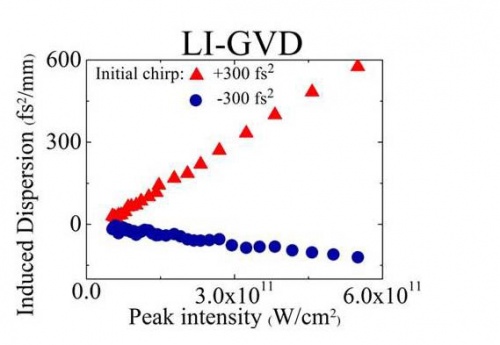
We present 20fs(2) accuracy laser-induced group velocity dispersion (LI-GVD) measurements, resulting from propagation of a femtosecond laser pulse in 1mm of fused silica, as a function of peak intensity. For a 5.5 × 10(11) W/cm(2) peak intensity, LI-GVD values are found to vary from -3 to + 15 times the material GVD. Normal induced dispersion can be explained by the Kerr effect, but anomalous LI-GVD, found when the input pulses have negative pre-chirp, cannot. These findings have significant implications regarding self-compression and the design of femtosecond lasers.
Additional Information
Researchers at Michigan State University discovered that fused silica can exhibit anomalous dispersion at 800nm under certain conditions. When an intense laser pulse enters a dielectric medium, it perturbs the medium causing nonlinear changes of the index of refraction. Given that nonlinear refractive index changes are expected to depend on pulse intensity, the researchers were surprised to find that laser-induced group velocity dispersion depends on the sign of the input chirp.
Taking advantage of their ability to control the spectral phase of the input laser pulses, and measuring the nonlinear intensity-dependent changes in the index of refraction, the researchers found that intense negatively chirped pulses acquired additional negative chirp, which is considered as anomalous. Zero dispersion wavelength for fused silica lies near 1300nm and for light with shorter wavelength the material dispersion naturally occurs to be normal (positive).
This finding could have significant applications in design of ultrafast lasers such as titanium sapphire lasers, or ytterbium fiber lasers where fused silica is the main propagation medium. The research was carried out by the Dantus Research Group, developer of MIIPS technology for automated pulse compression.