Advances in Engineering Advances in Engineering features breaking research judged by Advances in Engineering advisory team to be of key importance in the Engineering field. Papers are selected from over 10,000 published each week from most peer reviewed journals.

Applied Clay Science, Volume 107, April 2015, Pages 117–121.
Gökhan Elmaci, Okan Icten, Ahmet Nedim Ay, Birgül Zümreoglu-Karan.
Department of Chemistry, Faculty of Science, Hacettepe University, 06800 Ankara, Turkey.
Abstract
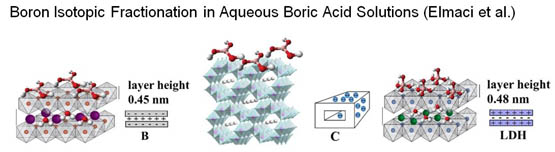
Boron isotopic fractionation in boric acid solutions during adsorption on synthetic manganese oxides (birnessite “B” and cryptomelane “C”) and Mg–Al-layered double hydroxide “LDH” was investigated. The materials were characterized by elemental analyses, powder X-ray diffraction, FTIR spectra, BET surface area and zeta potential measurements. Batch experiments were conducted without changing the solution pH to correlate the boron sorption properties of the adsorbents with isotopic fractionation in the associated boric acid solutions. The results showed that boron isotopic composition of the contact solution is heavily dependent on the selective adsorption of B(OH)3 or B(OH)4− species due to the charge properties of the minerals. With B and C, possessing negatively charged surfaces, 10B(OH)4− was preferentially fractionated in the solution due to the transfer of the Lewis acidic 11B(OH)3 species while with LDH selective adsoption of 10B(OH)4− by positive layers was favorable resulting in the enrichment of the heavier isotope in the solution
Significance Statement
This work indicates that boron isotopes in boric acid solutions fractionate during boron adsorption by minerals. Our findings suggest that surface charge employs a predominant control on the fractionation factor. The minerals possessing negative layer/surface charge selectively adsorb trigonal 10B species while those having positively charged layers selectively adsorb 11B(OH)4¯ species, thus changing the isotope ratio in the contact solution . The results of this study emphasize the role of synthetic minerals in boron isotopic fractionation processes in terms of nanolayer/surface charge and are expected to attract the attention of surface chemists to isotope fractionation problems.