Advances in Engineering Advances in Engineering features breaking research judged by Advances in Engineering advisory team to be of key importance in the Engineering field. Papers are selected from over 10,000 published each week from most peer reviewed journals.

Journal of Polymer Science Part A: Polymer Chemistry, Vol.52, No.15, 2139-2145, 2014.
Nicholas Stanley1, Georgiana Bucataru1, Yong Miao1, Audrey Favrelle1, Marc Bria2, Francois Stoffelbach3, Patrice Woisel4 and Philippe Zinck1,*
Abstract
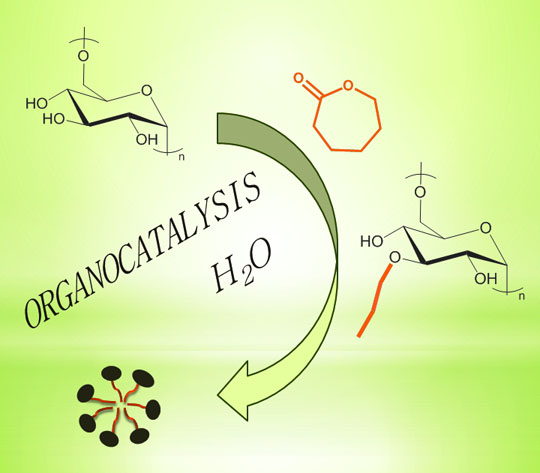
The polymerization of ε-caprolactone (epsilon-CL) has been assessed in water using various Bronsted acids as catalysts. The reaction was found to be quantitative at 100 degrees C, leading to number-average molecular weights up to 5000 g mol(-1). The Bronsted acid-catalyzed polymerization of epsilon-CL in water was further conducted in the presence of water-soluble polysaccharides thereby affording graft copolymers. The approach enables an easy, mild access to dextran hydroxyesters. For low degree of substitution, the latter self-assembles in water to form nanoparticles. Poly(epsilon-CL)-graft-methylcellulose copolymers can also be obtained via a similar approach. It is note-worthy that the methodology reported herein is a one-step route to poly(ε-caprolactone)-graft-water-soluble polysaccharides, operating in mild conditions, that is, at low temperatures, using readily available metal-free catalysts and water as a solvent. (C) 2014 Wiley Periodicals, Inc.
Go To Journal of Polymer Science Part A: Polymer Chemistry
Additional information
The functionalization of polysaccharides with biocompatible polymers such as aliphatic polyesters is of particular interest regarding biomedical and food packaging applications notably. Indeed, this will lead to graft copolymers having properties that combine those of hydrophobic polyesters with those of the polysaccharide while keeping the biocompatible / biodegradable character of the precursors. The hydrophilic/hydrophobic balance can eventually lead to supramolecular structures such as micelles able to carry drugs in the body. Such functionalizations are often conducted via multistep reactions, involving toxic solvents, metal based catalysts and purification of reagents. Some recent studies reporting the ring-opening polymerization of cyclic esters in water prompted us to realize the functionalization of water soluble polysaccharides with aliphatic polyesters in aqueous medium. Brönsted acids were first successfully assessed as organocatalysts for the ring-opening polymerization of ε-caprolactone in water. We established then a one-step route to dextran-graft-poly(ε-caprolactone) and methylcellulose-graft-poly(ε-caprolactone) starting from unpurified reagents, operating in water at mild temperatures and using readily available Brönsted acids as metal-free catalysts. Some of the resulting graft copolymers self-assemble into particles of diameter 50–80 nm in water.