Advances in Engineering Advances in Engineering features breaking research judged by Advances in Engineering advisory team to be of key importance in the Engineering field. Papers are selected from over 10,000 published each week from most peer reviewed journals.

Reactive and Functional Polymers (impact factor: 2.48). 01/2012; 72:420-426.
J. M. Valente, H. D. Burrows, J. N. P. L. Gomes, R. F. P. Pereira, D. Cerqueira, A. Jimenez, N. Burgos, C. Moran, R. Mallavia, G. R. Filho
Department of Chemistry, University of Coimbra, 3004-535 Coimbra, Portugal
Instituto de Ciências Ambientais e Desenvolvimento Sustentável, Universidade Federal da Bahia, Rua Prof. José Seabra, S/N, CEP 47805-100 Barreiras, Bahia, Brazil
Department of Analytical Chemistry, Nutrition and Food Sciences, University of Alicante, PO Box 99, 03080 Alicante, Spain
Instituto de Biologia Molecular y Celular, Universidad Miguel Hernández, Elche 03202, Alicante, Spain
Instituto de Química, Universidade Federal de Uberlândia, Av. João Naves de Ávila 2121, CEP 38400-902, Cx. P. 593 Uberlândia, Minas Gerais, Brazil
Abstract
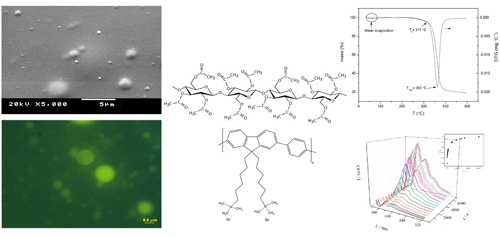
The preparation of cellulose acetate-poly-(9,9-bis(6′-N,N,N-trimethylammonium)-hexyl-fluorene phenylene) bromide (HTMA-PFP) blend films by solvent casting from a dispersion is reported. Films were characterized by UV-visible spectroscopy, SEM, electrical conductivity, TGA and DSC. It was found that morphological and physical chemical properties of blends were dependent both on the solvent and the degree of polymerization of cellulose acetate. The fluorescence properties of different blends were evaluated by fluorescence microscopy and it was shown that they are dependent on the structural properties of the blend as well as the aggregation level of the polyfluorene. Release kinetics of HTMA-PFP, incorporated into blend films, in SDS aqueous solutions have been studied and are discussed on the basis of the Korsmeyer-Peppas equation. (C) 2012 Elsevier Ltd. All rights reserved..
Additional Information
Conjugated polyelectrolytes (CPEs) are emerging as important materials for a variety of scientific and technological applications, including light emitting and charge injection layers for organic and polymer based light emitting diodes (OLEDs and PLEDs) chemical and biological sensing, biological imaging, biocides (1). For many of these, thin films are desirable. While CPEs can be deposited directly as thin layers, stability and mechanical properties are enhanced when they are blending with film-forming polymers. We show that excellent free-standing fluorescent films of the important CPE poly{[9,9-bis(6′-N,N,N-trimethylammonium)hexyl]fluorene-phenylene} bromide can be prepared with cellulose acetate (CA) and that properties and CPE aggregation in these can be tuned by through solvent and degree of CA polymerization (2). These have potential both for sensing, optoelectronics and controlled release of active materials. Both these (CA) and films of poly(aniline) with CA (3) show particular potential for sensing common anionic detergents, such as sodium dodecyl sulfate, which is important for environmental monitoring.