Advances in Engineering Advances in Engineering features breaking research judged by Advances in Engineering advisory team to be of key importance in the Engineering field. Papers are selected from over 10,000 published each week from most peer reviewed journals.

Chemistry – A European Journal, Volume 19, Issue 27, pages 8806–8813, 2013.
Dr. Yumei Lin, Dewang Xie, Prof. Dr. Werner Massa, Dr. Leonhard Mayrhofer,Sina Lippert, Benjamin Ewers, Dr. Alexey Chernikov, Prof. Dr. Martin Koch,Prof. Dr. Stefanie Dehnen.
Fachbereich Chemie and Wissenschaftliches Zentrum für Materialwissenschaften (WZMW), Philipps-Universität Marburg, Hans-Meerwein Strasse, 35043 Marburg (Germany), Fax: (+49) 6421-282-5653 and
Fachbereich Physik, Philipps-Universität Marburg, Renthof 5, 35037 Marburg (Germany) and
Fraunhofer-Institut für Werkstoffmechanik IWM, Wöhlerstrasse 11, 79108 Freiburg (Germany).
Abstract
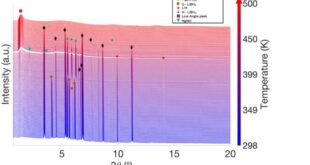
In situ transformations of selenidostannate frameworks in ionic liquids (ILs) were initiated by treatment of the starting phase K2[Sn2Se5] and the consecutive reaction products by means of temperature increase and/or amine addition. Along the reaction pathway, the framework dimensionalities of the five involved selenidostannate anions develop from 3D to 1D and back, both in top-down and bottom-up style. Addition of ethane-1,2-diamine (en) led to the reversion of the 2D→1D step from 2D-{[Sn24Se56]16−} to 1D-{[Sn6Se14]4−}. As rationalized by DFT investigations, the 2D anion is thermodynamically favored. Photoconductivity measurements reveal that all samples show Schottky contact behavior with absolute thresholds below 10 V. One of the samples exhibits conductive states within the energy range of visible photons.
Copyright © 2013 WILEY-VCH Verlag GmbH & Co. KGaA, Weinheim