Advances in Engineering Advances in Engineering features breaking research judged by Advances in Engineering advisory team to be of key importance in the Engineering field. Papers are selected from over 10,000 published each week from most peer reviewed journals.

Chemical Engineering Journal, Volume 239, 2014, Pages 75-86.
F. Raganati, V. Gargiulo, P. Ammendola, M. Alfe, R. Chirone.
Dipartimento di Ingegneria Chimica, dei Materiali e della Produzione Industriale, Università Federico II di Napoli, P.le V. Tecchio, 80-80125 Naples, Italy and
Istituto di Ricerche sulla Combustione – CNR, P.le V. Tecchio, 80-80125 Naples, Italy.
Abstract
Among the CCS technologies, adsorption processes are attractive due to their low energy requirements, stimulating recent research to find suitable and highly specific adsorbents for removing CO2 from flue gas. Much attention has been focused on metal–organic frameworks (MOF), a new class of microporous materials that have potential applications in separation processes. As regards the handling of such fine materials, sound-assisted fluidization has been indicated as one of the best technological option to improve the gas–solid contact by promoting a smooth fluidization regime. The present work is focused on the CO2capture by sound assisted fluidized bed of a specific MOF, HKUST-1. Tests have been performed in a laboratory scale experimental set-up at ambient temperature and pressure, pointing out the effect of sound parameters (intensity and frequency) and CO2 partial pressure. Effectiveness of CO2 adsorption has been assessed in terms of the moles of CO2 adsorbed per unit mass of adsorbent, the breakthrough time, the adsorption rate and the fraction of bed utilized at breakpoint. The results show the capability of the sound in promoting a more efficient adsorption process. Finally experimental tests have been carried out to find a possible regeneration strategy of the sorbent. The stability of the material has been assessed performing different chemico-physical characterizations (BET, XRD, TG, FT-IR and granulometric distribution) on a sample of HKUST-1 subjected to 10 CO2 adsorption/desorption cycles.
Additional information
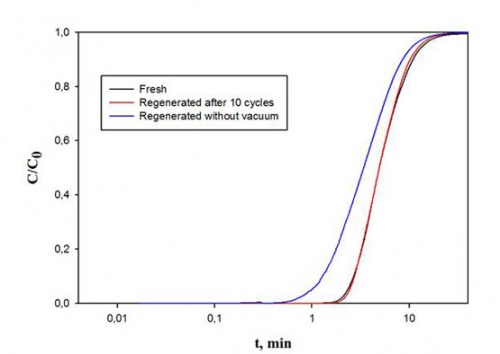
In this work sound assisted fluidization has been applied to HKUST-1 in order to evaluate its CO2 capture efficiency under more realistic process conditions than those already experimented in literature. To this aim, the synthesis strategy has been up-scaled to the gram-scale, for the powder to be used in a lab-scale fluidization column. The application of the sound confirms its ability to improve the gas–solid contact as well as the adsorption efficiency. As regards the influence of CO2 partial pressure, the increase of the CO2 inlet concentration corresponds to an increase of CO2 uptake and a decrease of tb. The experimental results also show that, in spite of the up- scaled synthesis procedure, HKUST-1 capture capacity is remarkably higher than the values typically reported in literature for CO2 partial pressure of 0.1–0.15 atm. Finally TPD analyses have been performed on HKUST-1 in order to choose the best regeneration strategy. Since a sole thermal treatment is not effective to properly regenerate HKUST-1, an extra-situ mixed regeneration strategy has been adopted: the sample has been heated up to 150°C under a vacuum of 50mbar. The adsorption tests performed using a sample, which has been subjected to 10 adsorption/desorption cycles, confirm the effectiveness of this regeneration strategy. Indeed, HKUST-1 adsorption effectiveness can be properly reproduced. A further characterization of the cycled sample confirms that HKUST-1 keeps its chemico-physical features. In particular, the capture capacity of HKUST-1 strongly depends on narrow micro-pores, namely pores smaller than 12 Å, which can also affect the accessibility of the metal sites.
Figured Legend
The figure below shows the breakthrough curves obtained for the fresh prepared HKUST-1 and after regeneration. Sound intensity = 140dB, Sound frequency = 120Hz; Inlet CO2 concentration = 15%; Superficial gas velocity = 1.5cm/s.