Advances in Engineering Advances in Engineering features breaking research judged by Advances in Engineering advisory team to be of key importance in the Engineering field. Papers are selected from over 10,000 published each week from most peer reviewed journals.

Chemical Engineering Journal, Volume 262, 15 February 2015, Pages 737-746.
S.M. Pérez-Moreno1, M.J. Gázquez1,2, J.P. Bolívar1
- Departmento de Física Aplicada, Universidad de Huelva, Huelva, Spain and
- Departamento de Química, Universidad Técnica Particular de Loja, Loja, Ecuador.
Abstract
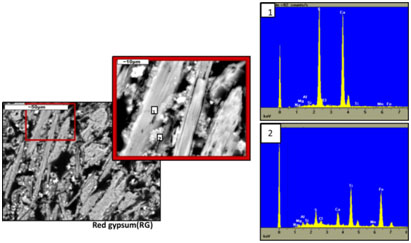
In this paper, the use of red gypsum (RG), waste from the naturally occurring radioactive materials industry that is devoted to the production of the TiO2 pigment, was evaluated as a source of calcium for CO2sequestration by an indirect carbonation process. The main objective was to valorise this waste and, at the same time, analyse the reduction of greenhouse gas emissions (CO2) emitted by industrial sources that use this process. In order to induce the carbonation process, the extraction of calcium from the sample was required beforehand. For this, two different extraction routes were applied (the NaOH and NH4OH pathways). The obtained results demonstrate that RG has high carbonation reactivity, depending on the extraction agent used at room temperature and pressure. The conversion of RG to calcium carbonate was 92% when using sodium hydroxide, whereas 64% was obtained with ammonium hydroxide extracting. The behaviour and fluxes of the radionuclides and trace elements, initially contained in the RG, were also evaluated during the full carbonation process. In general, the levels of pollutants in the final calcite (calcium carbonate) were comparable to the ones found for typical unperturbed soils.
Go To Chemical Engineering Journal