Advances in Engineering Advances in Engineering features breaking research judged by Advances in Engineering advisory team to be of key importance in the Engineering field. Papers are selected from over 10,000 published each week from most peer reviewed journals.

Matthias Kellermeier, Denis Gebauer, Emilio Melero-Garcia, Markus Drechsler, Yeshayahu Talmon, Lorenz Kienle, Helmut Cölfen, Juan Manuel Garcia-Ruiz, Werner Kunz.
Advanced Functional Materials,Volume 22, Issue 20, pages 4301–4311, October 23, 2012.
Physical Chemistry, University of Konstanz, Universitatsstrasse 10, 78457 Konstanz, Germany.
Laboratorio de Estudios Cristalográficos, IACT (CSIC-UGR), Avda. del Conocimiento s/n, P.T. Ciencias de la Salud, 18100 Armilla, Spain.
Institute of Macromolecular Chemistry II, University of Bayreuth, Universitatsstrasse 30, 95440 Bayreuth, Germany.
Department of Chemical Engineering, Technion-Israel Institute of Technology, Haifa 32000, Israel.
Technical Faculty, Christian-Albrechts-University Kiel, Kaiserstrasse 2, 24143 Kiel, Germany.
Institute of Physical and Theoretical Chemistry, University of Regensburg, Universitatsstrasse 31, 93053 Regensburg, Germany.
Abstract
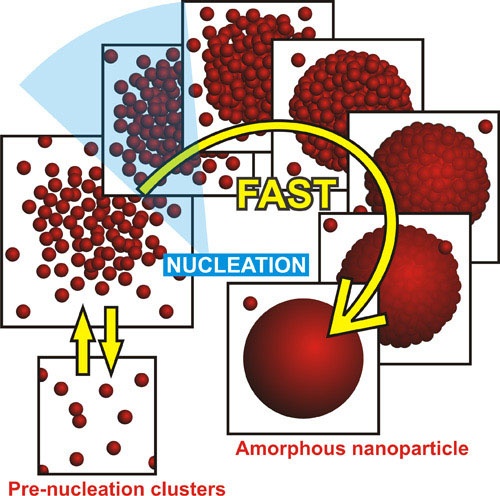
Calcium carbonate precipitation proceeds via a complex multistage scenario involving neutral ion clusters as precursors and amorphous phases as intermediates, which finally transform to crystals. Although the existence of stable clusters in solution prior to nucleation has been demonstrated, the molecular mechanisms by which they precipitate are still obscure. Here, direct insight into the processes that drive the transformation of individual clusters into amorphous nanoparticles is provided by progressive colloidal stabilization of different transient states in silica-containing environments. Nucleation of calcium carbonate in the presence of silica can only take place via cluster aggregation at low pH values. At higher pH, prenucleation clusters become colloidally stabilized and cannot aggregate. Nucleation through structural reorganization within the clusters is not observed under these conditions, indicating that this pathway is blocked by kinetic and/or thermodynamic means. The degree of stabilization against nucleation is found to be sufficient to allow for a dramatic enrichment of solutions with prenucleation clusters and enable their isolation into the dry state. This approach renders direct analyses of the clusters by conventional techniques possible and is thus likely to facilitate deeper insight into the chemistry and structure of these elusive species in the future.
Copyright © 2012 WILEY-VCH Verlag GmbH & Co. KGaA, Weinheim.