 Advances in Engineering Advances in Engineering features breaking research judged by Advances in Engineering advisory team to be of key importance in the Engineering field. Papers are selected from over 10,000 published each week from most peer reviewed journals.

AIChE Journal, Volume 59, Issue 1, pages 200–214, January 2013.
Muhammad Atiqullah*1, Mohammad M. Hossain2, Muhammad S. Kamal2, Mamdouh A. Al-Harthi2, Anwar Hossaen1, Masiullah J. Khan2, and Ikram Hussain1
1Center for Refining & Petrochemicals (CRP), Research Institute; Center of Research Excellence in Petroleum Refining and Petrochemicals; King Fahd University of Petroleum & Minerals, Dhahran 31261, Saudi Arabia.
2Department of Chemical Engineering, King Fahd University of Petroleum & Minerals, Dhahran 31261, Saudi Arabia.
*Correspondence to: [email protected] (M. Atiqullah)
Abstract
The PE-b-PMMA diblock copolymer has important interfacial applications. Hence, PE-b–isotactic PMMA diblock copolymer, including isotactic PMMA, and PE homopolymer, was synthesized using SiMe2(Ind)2ZrMe2; the polymerization mechanisms and the origin of PMMA tacticity were duly explained. The crystallization kinetics of the as-synthesized polyethylenes was investigated by developing an appropriate nonisothermal Avrami-Erofeev crystallization model. For both polymers, the model predicted cylindrical crystal growth and well matched the entire DSC crystallinity profile, notably for a single Avrami-Erofeev index, and crystal growth dimension. The present model particularly overcomes the limitations of all the published nonisothermal crystallization models, and provides interesting insight into PE crystallization; crystallization mechanism does not change. The PMMA block significantly decreased the heats of crystallization and fusion, %crystallinity, and the relative crystallization function; increased the crystallization rate constant; and introduced minimal dilution effect whereas the PE block formed a continuous or percolated phase. This study correlates catalyst structure, copolymer block tacticity, and polyethylene nonisothermal crystallization and melting behavior. The catalyst structure covers active center multiplicity, electronic and steric effects, and variational coordination environments. The conceptus of this study is not restricted to a PE homopolymer and a PE-b-isotactic PMMA block copolymer. It can be generally applied to crystalline homopolymers and copolymers (alternating, random, and block), as well as their blends. The block copolymers and blends can be crystalline-amorphous as well as crystalline-crystalline.
Copyright © 2012 American Institute of Chemical Engineers (AIChE)
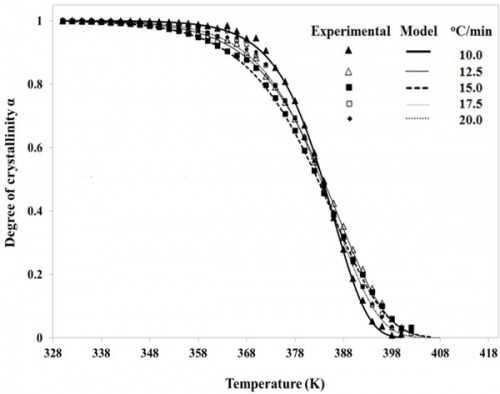
Figure Legend: Excellent match between model and experiment
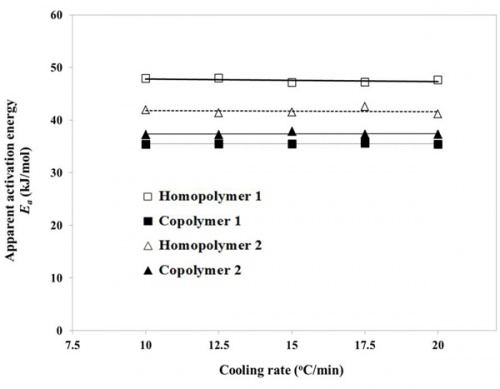
Figure Legend: Invariance of crystallization activation energy
Additional Information from the Authors:
This work has been later on extended to investigate the melting and crystallization behaviors of the above polymers as well as ethylene-1-hexene copolymers, using multiple heating and cooling rate DSC experiments. These copolymers were prepared using the supported metallocene catalysts synthesized in our laboratory. It is found, in each case, that the apparent crystallization activation energy Ea hardly varied with cooling rate, relative crystallinity (α), and crystallization temperature or time. This refutes the mechanistically unsound concept of variable/instantaneous activation energy, which has been widely used in the literature to handle nonisothermal transformation processes. The use of the right crystallization model and parameter estimation algorithm is important to address the involved mathematical artifact. The characteristic shapes of the crystallization function f(α(T)) versus 1/T and crystallization rate j versus α plots, the resulting Tcmax and narrow amax range can guide to search for an appropriate crystallization model. The exclusiveness of the PMMA block and butyl branch from chain folding, hence from the crystalline PE phase, is established. This knowledge can be correlated to polymer morphology to generate new end-product applications. The steric hindrance imparted by the block copolymer (having the pendant ¾CH3 and bulky ¾COOCH3 groups) was identified to be the reason for its higher crystallization activation energy than the linear homopolymer. Finally, the model, combined with DSC experiments, well illustrates how catalyst active center multiplicity and the resulting backbone structure affect crystallization behavior. This will potentially open new routes to develop supported advanced metallocene, post-metallocene, and late transition metal catalysts that can create new-microstructured olefin copolymers and hence, novel applications.
