Significance Statement
Diamond is the hardest material on Earth, however, diamond is susceptible for oxidation while cutting through iron, cobalt, nickel, chromium, or vanadium at high temperatures. On the other hand, Cubic boron nitride is the second hardest material, after diamond and has the advantage of being chemically inert. Researchers from Sichuan University in Chengdu, China and University of Nevada have created an alloy composed of diamonds and cubic boron nitride that boasts the benefits of both.
To synthesize diamond- Cubic boron nitride alloys, the researchers subjected a homogenous mixture of diamond and cubic boron nitride powder to a vacuum furnace at 1300 K for two hours, then pressed the material into 3.5 millimeter pellets under pressure greater than 15 gigapascals and temperatures above 2000 K. The pellets were then polished and sharpened into cutting implements. This new material has many potential applications to be the ideal cutting tool once it become produced at industrial scale.
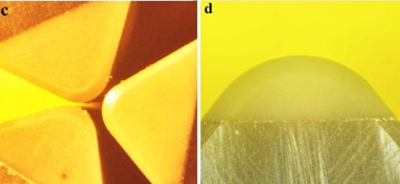
Figure legend: Polished rake faces of diamond-Cubic boron nitride alloy cutters. Credit: D. W. He/SCU

Journal Reference
Appl. Phys. Lett. 107, 101901 (2015)
Pei Wang1,2, Duanwei He1,a), Liping Wang2, Zili Kou1, Yong Li1, Lun Xiong3,Qiwei Hu1, Chao Xu1, Li Lei1, Qiming Wang1, Jing Liu3 and Yusheng Zhao2
[expand title=”Show Affiliations”]
1 Institute of Atomic and Molecular Physics, Sichuan University, Chengdu 610065, People’s Republic of China
2 High Pressure Science and Engineering Center and Department of Physics and Astronomy, University of Nevada Las Vegas, Las Vegas, Nevada 89154, USA
3 Institute of High Energy Physics, Chinese Academy of Sciences, Beijing 100049, People’s Republic of China
[/expand]
Abstract
Diamond and cubic boron nitride (c BN) as conventional superhard materials have found widespread industrial applications, but both have inherent limitations. Diamond is not suitable for high-speed cutting of ferrous materials due to its poor chemical inertness, while cubic boron nitride is only about half as hard as diamond. Because of their affinity in structural lattices and covalent bonding character, diamond and cubic boron nitride could form alloys that can potentially fill the performance gap. However, the idea has never been demonstrated because samples obtained in the previous studies were too small to be tested for their practical performance. Here, we report the synthesis and characterization of transparent bulk diamond-cubic boron nitride alloy compacts whose diameters (3 mm) are sufficiently large for them to be processed into cutting tools. The testing results show that the diamond-cubic boron nitride Alloy alloy has superior chemical inertness over polycrystalline diamond and higher hardness than single crystal cubic boron nitride. High-speed cutting tests on hardened steel and granite suggest that Diamond-cubic boron nitride Alloy alloy is indeed a universal cutting material.
Diamond-Cubic boron nitride alloy featured on Advances in Engineering the World’s leading source of Engineering research news
 Advances in Engineering Advances in Engineering features breaking research judged by Advances in Engineering advisory team to be of key importance in the Engineering field. Papers are selected from over 10,000 published each week from most peer reviewed journals.