Advances in Engineering Advances in Engineering features breaking research judged by Advances in Engineering advisory team to be of key importance in the Engineering field. Papers are selected from over 10,000 published each week from most peer reviewed journals.

Significance Statement
Dutch and German scientists developed a new solar fuel cell. They used gallium phosphide nanowires which enabled solar cell to produce ten times clean fuel hydrogen gas from liquid water. This novel solar fuel cell is more effective and thousands of times cheaper.
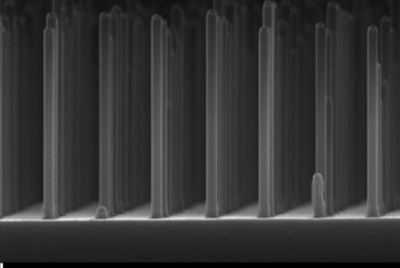
Figure Legend: Array of nanowires gallium phosphide made with an electron microscope.
Credit: Eindhoven University of Technology
Journal Reference
Standing A1, Assali S2, Gao L3, Verheijen MA4, van Dam D2, Cui Y2, Notten PH5, Haverkort JE2, Bakkers EP6. Nat Commun. 2015 Jul 17;6:7824.
[expand title=”Show Affiliations”]11] Department of Applied Physics, Eindhoven University of Technology, 5600 MB Eindhoven, The Netherlands [2] BioSolar Cells, P.O. Box 98, 6700 AB Wageningen, The Netherlands.
2Department of Applied Physics, Eindhoven University of Technology, 5600 MB Eindhoven, The Netherlands.
3Department of Chemical Engineering and Chemistry, Eindhoven University of Technology, 5600 MB Eindhoven, The Netherlands.
4Department of Applied Physics, Eindhoven University of Technology, 5600 MB Eindhoven, The Netherlands [2] Philips Innovation Services Eindhoven, High Tech Campus 11, 5656AE Eindhoven, The Netherlands.
5Department of Chemical Engineering and Chemistry, Eindhoven University of Technology, 5600 MB Eindhoven, The Netherlands [2] Forschungszentrum Jülich (IEK-9), D-52425 Jülich, Germany.
6Department of Applied Physics, Eindhoven University of Technology, 5600 MB Eindhoven, The Netherlands [2] Kavli Institute of Nanoscience Delft, Delft University of Technology, 2628 CJ Delft, The Netherlands.
[/expand]ABSTRACT
Photoelectrochemical hydrogen production from solar energy and water offers a clean and sustainable fuel option for the future. Planar III/V material systems have shown the highest efficiencies, but are expensive. By moving to the nanowire regime the demand on material quantity is reduced, and new materials can be uncovered, such as wurtzite gallium phosphide, featuring a direct bandgap. This is one of the few materials combining large solar light absorption and (close to) ideal band-edge positions for full water splitting. Here we report the photoelectrochemical reduction of water, on a p-type wurtzite gallium phosphide nanowire photocathode. By modifying geometry to reduce electrical resistance and enhance optical absorption, and modifying the surface with a multistep platinum deposition, high current densities and open circuit potentials were achieved. Our results demonstrate the capabilities of this material, even when used in such low quantities, as in nanowires.