Advances in Engineering Advances in Engineering features breaking research judged by Advances in Engineering advisory team to be of key importance in the Engineering field. Papers are selected from over 10,000 published each week from most peer reviewed journals.

J. Am. Chem. Soc., 2014, 136(1), pp 419–426.
Xujie Lü *†‡, Wenge Yang ‡§*, Zewei Quan ∥,Tianquan Lin ⊥, Ligang Bai †, Lin Wang ‡§,Fuqiang Huang ⊥, Yusheng Zhao *†
† High Pressure Science and Engineering Center,University of Nevada, Las Vegas, Nevada 89154, United States and
‡ High Pressure Synergetic Consortium, Geophysical Laboratory, Carnegie Institution of Washington, Argonne, Illinois 60439, United States and
§Center for High Pressure Science and Technology Advanced Research, Pudong, Shanghai 201203,People’s Republic of China and
∥ Earth and Environmental Sciences Division, Los Alamos National Laboratory, Los Alamos, New Mexico 87545, United States and
⊥ CAS Key Laboratory of Materials for Energy Conversion, Shanghai Institute of Ceramics, Chinese Academy of Sciences, Shanghai 200050, People’s Republic of China
Abstract
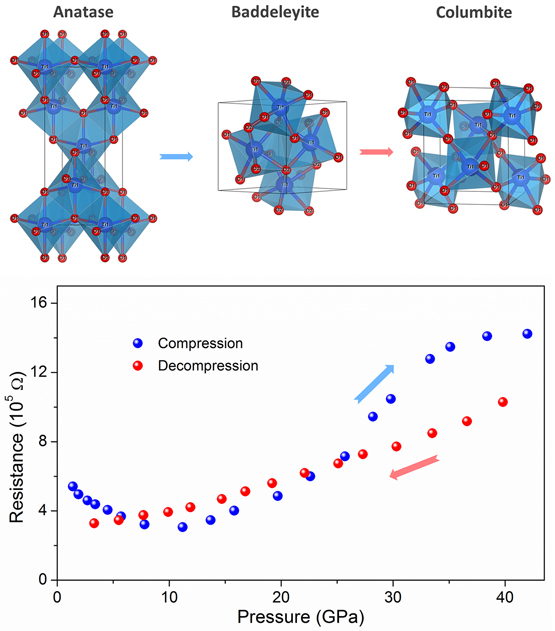
Anatase TiO2 is one of the most important energy materials but suffers from poor electrical conductivity. Nb doping has been considered as an effective way to improve its performance in the applications of photocatalysis, solar cells, Li batteries, and transparent conducting oxide films. Here, we report the further enhancement of electron transport in Nb-doped TiO2 nanoparticles via pressure-induced phase transitions. The phase transition behavior and influence of Nb doping in anatase Nb-TiO2 have been systematically investigated by in situ synchrotron X-ray diffraction and Raman spectroscopy. The bulk moduli are determined to be 179.5, 163.3, 148.3, and 139.0 GPa for 0, 2.5, 5.0, and 10.0 mol % Nb-doped TiO2, respectively. The Nb-concentration-dependent stiffness variation has been demonstrated: samples with higher Nb concentrations have lower stiffness. In situ resistance measurements reveal an increase of 40% in conductivity of quenched Nb-TiO2 in comparison to the pristine anatase phase. The pressure-induced conductivity evolution is discussed in detail in terms of the packing factor model, which provides direct evidence for the rationality of the correlation of packing factors with electron transport in semiconductors. Pressure-treated Nb-doped TiO2with unique properties surpassing those in the anatase phase holds great promise for energy-related applications.
Copyright © 2013 American Chemical Society
Significance statement
Anatase TiO2 is one of the most important energy materials but suffers from poor electrical conductivity. Nb doping has been considered as an effective way to improve its performance in the applications of photocatalysis, solar cells, Li batteries, and transparent conducting oxide films.
This work by Dr. Xujie Lü et al. reports the further enhancement of electron transport in Nb-doped TiO2nanoparticles via pressure-induced phase transitions. The phase transition behavior and influence of Nb doping in anatase Nb-TiO2 have been systematically investigated by in situ synchrotron X-ray diffraction and Raman spectroscopy. The bulk moduli are determined to be 179.5, 163.3, 148.3, and 139.0 GPa for 0, 2.5, 5.0, and 10.0 mol % Nb-doped TiO2, respectively. The Nb-concentration-dependent stiffness variation has been demonstrated: samples with higher Nb concentrations have lower stiffness. In situ resistance measurements reveal an increase of 40% in conductivity of quenched Nb-TiO2 in comparison to the pristine anatase phase. The pressure-induced conductivity evolution is discussed in detail in terms of the packing factor model, which provides direct evidence for the rationality of the correlation of packing factors with electron transport in semiconductors.
Such pressure-treated Nb-doped TiO2 with unique properties surpassing those in anatase phase hold great promise for energy-related applications. This study proposes a potential method to synthesize novel materials beyond those prepared at ambient conditions. The fully investigated relationship between conductivity and crystal packing factor provides a new perspective for ranking electron transport and photocatalytic properties, which will guide scientists to develop new efficient photocatalysts and may trigger extensive research on pressure-induced advanced materials.
Figure Legend
Pressure-induced structural and electrical resistance evolution.