Advances in Engineering Advances in Engineering features breaking research judged by Advances in Engineering advisory team to be of key importance in the Engineering field. Papers are selected from over 10,000 published each week from most peer reviewed journals.

Angewandte Chemie International Edition, Volume 51, Issue 44, pages 11010–11013, October 29, 2012
Steven Heylen, Lennart Joos, Prof. Tatjana N. Parac-Vogt, Prof. Veronique Van Speybroeck, Prof. Christine E. A. Kirschhock, Prof. Johan A. Martens
Center for Surface Chemistry and Catalysis, KU Leuven, Kasteelpark Arenberg 23, 3001 Heverlee (Belgium)
Center for Molecular Modeling, Ghent University, Technologiepark 903, 9052 Zwijnaarde (Belgium)
Molecular Design and Synthesis, KU Leuven, Celestijnenlaan 200f, 3001 Heverlee (Belgium)
Abstract
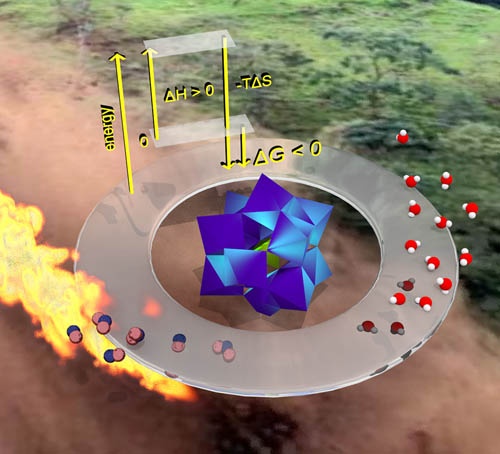
Free-energy calculations indicated that the NOx adsorption process on heteropolyacids is entropy-driven, as more gas molecules are released than adsorbed by substitution of H5O2+ with NO+ species. P yellow, W light blue, O red, H pink, N small dark blue spheres
Copyright © 2012 WILEY-VCH Verlag GmbH & Co. KGaA, Weinheim
Additional Information
NOx is one of the prominent pollutants in exhaust gases from internal combustion engines. The most widely used technologies for the abatement of NOx rely on adsorbents. We discovered Keggin type heteropolyacids reversibly trap NOx and behave totally different from common NOx adsorbents. When a heteropolyacid adsorbent is exposed to a NOx bearing gas mixtures, NOx adsorption occurs at high temperatures (above 120°C), and NOx desorption at low temperatures (below 120°C). The origin of this anomalous behavior was identified as entropic. NOx is competing with water molecules for the adsorption sites. At high temperature, the adsorption competition is in favor of NOx, while at low temperature water molecules are occupying the sites. Using a combination of advanced characterization tools including neutron diffraction and DFT calculations, we could reveal that NOx adsorption is one of the rare examples where adsorption is endothermic but driven by favorable entropy changes. A variety of heteropolyacids was investigated and we could identify the key parameters determining the suitability of a compound for trapping NOx. The possibility of reversible replacement of small molecules like water by NOx species is a prerequisite. Other NOx adsorbents like Ru/NaY and Ru/BaNaY zeolite also display replacement of H2O with NOx which indicates the entropy driven adsorption process might be extended. [1-2]
These findings may lead to a revolution in NOx adsorption technology. In one of the current NOx elimination technologies, the “NOx storage and reduction” concept, NOx is adsorbed as nitrate on a barium based adsorbent. Regeneration requires temporary rich excursions of the engine, entailing a fuel penalty. Using the heteropolyacid based adsorbent, regeneration can be achieved by cooling the adsorbent with intake air for the engine. Not only is regeneration of the adsorbent very easy, the NOx recirculated to the engine with the intake air also will have a beneficial effect on the combustion process itself.
Chem. Sci., 2010, 1, 763-771.
Chem.Mater. 2011, 23, 4606-4611.