Advances in Engineering Advances in Engineering features breaking research judged by Advances in Engineering advisory team to be of key importance in the Engineering field. Papers are selected from over 10,000 published each week from most peer reviewed journals.

The Journal of Supercritical Fluids, Volume 71, November 2012, Pages 26-44
Laura Gil, Sofía T. Blanco, Clara Rivas, Eduardo Laga, Javier Fernández, Manuela Artal, Inmaculada Velasco
Departamento de Quimica Fisica, Facultad de Ciencias, Universidad de Zaragoza, 50009 Zaragoza, Spain
Abstract
Over the last few decades, supercritical fluids technology has been intensively utilized in a wide variety of processes concerning many fields. Supercritical CO2 is the most popular supercritical solvent although not the only one; recently, several industrial processes have been developed by means of other types of fluids in the supercritical state, such as hexane. However, the solubility and selectivity of polar solutes in these non-polar molecules (CO2 and hexane) are not as good as desired. This problem can be avoided by adding polar co-solvents such as small-chain alcohols.
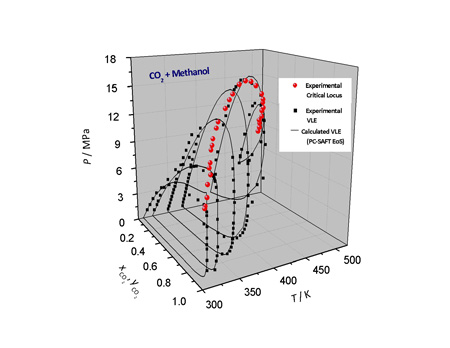
In this work, we determined experimental vapor-liquid critical locus (x, Tc, Pc) for n-C6H14 or CO2 + n-CmH2m+1OH (m = 1–4) systems over the whole range of compositions and we also performed a comprehensive bibliographic review for the critical locus and the vapor-liquid equilibrium. Moreover, we modelled the phase equilibria for these systems with modified PC-SAFT EoS; the pure compounds parameters were rescaled from their critical point values.
The results show that n-hexane + alcohols systems are well represented by PC-SAFT EoS when using a 2B association scheme for the alcohols (which takes into account the hydrogen bonding association) and only one temperature-dependent binary interaction parameter. The deviations obtained are MRD (Tc) = 0.47% and MRD (Pc) = 3.38% for the critical locus and MRD (P) = 2.90% and = 0.031 for the VLE.
In the CO2 + alcohol systems, in addition to the alcohol – alcohol hydrogen bonding and dispersive interactions some other specific interactions exist: carbon atom of CO2 – oxygen atom of alcohol and CO2 – alcohol hydrogen bonding. We obtained good results for the CO2 + methanol mixtures when including solvation phenomena in CO2 (the CO2 as a two-electron donor with two negative sites which are only active when mixed with a molecule with at least one positive or neutral site, 2C scheme), association in methanol (2B scheme), and only one temperature-dependent binary interaction parameter. For the rest of the alcohols, the net balance of the three types of specific interactions that seem to compete in these systems, in addition to the occasional opposed effects of temperature, pressure and composition, led us to choose a non-associated scheme; in this case, the temperature-dependent binary interaction parameters when representing the VLE and critical locus are different. For the CO2 + alcohol systems the deviations obtained are: MRD (Tc) = 1.91%, MRD (Pc) = 5.93%, MRD (P) = 7.07% and = 0.022.