 Advances in Engineering Advances in Engineering features breaking research judged by Advances in Engineering advisory team to be of key importance in the Engineering field. Papers are selected from over 10,000 published each week from most peer reviewed journals.

ACS Appl. Mater. Interfaces, 5 (24), pp 12811–12819. (2013).
Hui Shi, Congcong Liu, Jingkun Xu*, Haijun Song, Baoyang Lu, Fengxing Jiang, Weiqiang Zhou, Ge Zhang, Qinglin Jiang.
Jiangxi Key Laboratory of Organic Chemistry, Jiangxi Science and Technology Normal University, Nanchang 330013, China.
Abstract
A pure organic PEDOT:PSS nanofilm was used as a working electrode for the first time to electrodeposit polymer films of polythiophene (PTh) and its derivatives in a boron trifluoride diethyl ether (BFEE) solution, fabricating a novel generation of bilayered nanofilms. Cyclic voltammetry (CV) demonstrated good electrochemical stability of the as-formed films. Structures and surface morphologies were systematically investigated by the characterizations of cross-section SEM, FT-IR, UV–vis, SEM, and AFM. The resulting films revealed stable and enhanced thermoelectric (TE) performances. The electrical conductivity values of PEDOT:PSS/PTh, PEDOT:PSS/P3MeT, and PEDOT:PSS/P3HT nanofilms were determined to be 123.9, 136.5, and 200.5 S cm–1, respectively. The power factor reached up to be a maximum value of 5.79 μW m–1 k–2. Thus, this technique offers a facile approach to a class of bilayered nanofilms, and it may provide a general strategy for fabricating a new generation of conducting polymers for more practical applications.
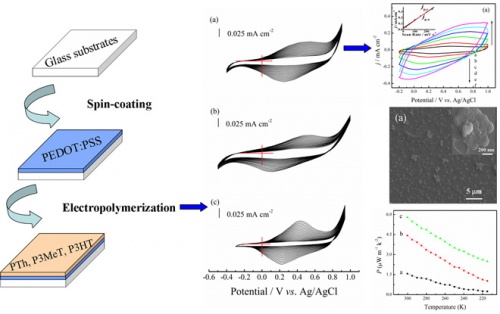
Fig. 1 The pure organic PEDOT:PSS electrodes used to electrodeposite polymer films of polythiophenes and the characterizations.
Additional Information:
Recently, conducting polymers have been attracted considerable scientific interest, and have been widely applied in solar cells, light-emitting diodes, sensors, thermoelectric materials etc. Among them, PEDOT:PSS is the most successful conducting polymer owing to its solution processability, high transparency, and excellent thermal stability. The PEDOT:PSS nanofilms have been served as transparent electrode of optoelectronic devices. However, there has been no report on the PEDOT:PSS nanofilms electrode for the electropolymerization.
In the present work, a pure organic PEDOT:PSS nanofilm was used as working electrode for the first time to electrodeposite polymer films of polythiophene (PTh) and its derivatives in a boron trifluoride diethyl ether (BFEE) solution, fabricating a novel generation of bilayered nanofilms. Compared with the traditional working electrodes such as metal, inorganic non-metallic, and carbon materials, the pure organic PEDOT:PSS electrode possesses the advantages of low cost, simple process, easy degradation, and non-pollution. In addition, the as-formed PEDOT:PSS/PThs films showed good electrochemical stability and enhanced thermoelectric (TE) performance, and their power factor reached a maximum of 5.79 μW m-1 K-2. Accordingly, the pure organic PEDOT:PSS electrode is of great significance in the field of electropolymerization, and this technique provides a facile and general method for synthesizing electric materials with better properties for a wider array of applications.
