Advances in Engineering Advances in Engineering features breaking research judged by Advances in Engineering advisory team to be of key importance in the Engineering field. Papers are selected from over 10,000 published each week from most peer reviewed journals.

Opt Lett. 2013;38(7):1158-60.
Ogiwara A, Watanabe M, Moriwaki R.
Department of Electronic Engineering, Kobe City College of Technology, Kobe, Japan. ogiwara@kobe kosen.ac.jp
Abstract
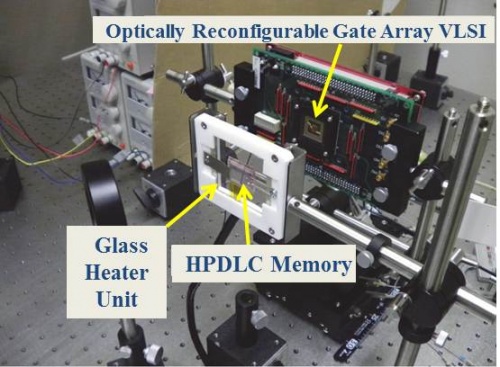
Grating devices using photosensitive organic materials play an important role in the development of optical and optoelectronic systems. High diffraction efficiency and polarization dependence achieved in a holographic polymer-dispersed liquid crystal (HPDLC) grating are expected to provide polarization controllable optical devices, such as the holographic memory for optically reconfigurable gate arrays (ORGAs). However, the optical property is affected by the thermal modulation around the transition temperature (T(ni)) that the liquid crystal (LC) changes from nematic to isotropic phases. The temperature dependence of the diffraction efficiency in HPDLC grating is discussed with two types of LC composites comprised of isotropic and LC diacrylate monomers. The holographic memory formed by the LC and LC diacrylate monomer performs precise reconstruction of the context information for ORGAs at high temperatures more than 150°C