Advances in Engineering Advances in Engineering features breaking research judged by Advances in Engineering advisory team to be of key importance in the Engineering field. Papers are selected from over 10,000 published each week from most peer reviewed journals.

Am. Chem. Soc., 2014, 136(1), pp 44–47. Suvendu Sekhar Mondal †, Asamanjoy Bhunia ‡,Alexandra Kelling †, Uwe Schilde †, Christoph Janiak *‡, Hans-Jürgen Holdt *†
† Institut für Chemie, Anorganische Chemie, Universität Potsdam, Karl-Liebknecht-Straße 24-25, 14476 Potsdam, Germany and
‡ Institut für Anorganische Chemie und Strukturchemie,Heinrich-Heine-Universität Düsseldorf, Universitätsstraße 1, 40225 Düsseldorf, Germany.
Abstract
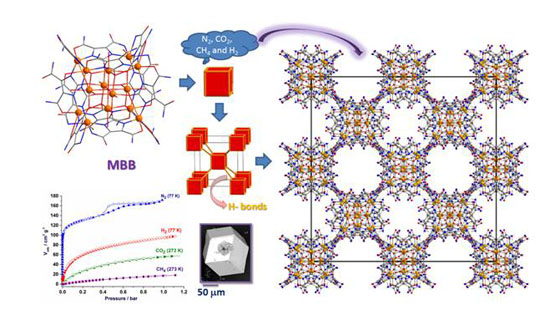
In situ imidazolate-4,5-diamide-2-olate linker generation leads to the formation of a [Zn14(L2)12(O)(OH)2(H2O)4] molecular building block (MBB) with a Zn6 octahedron inscribed in a Zn8 cube. The MBBs connect by amide–amide hydrogen bonds to a 3D robust supramolecular network which can be activated for N2, CO2, CH4, and H2 gas sorption.
Copyright © 2013 American Chemical Society
Additional information:
A team of researchers from the Institut für Chemie, Anorganische Chemie, Universität Potsdam, Germany, and from Institut für Anorganische Chemie und Strukturchemie, Heinrich-Heine-Universität Düsseldorf, Germany, have developed a novel approach for the synthesis of a hydrogen-bonded assembly of molecular building blocks (MBBs), by using an imidazolate- 4,5-diamide-2-olate linker which is formed in situ under solvothermal condition. The zinc atoms in the Zn(II)14-MBB formed the Zn6 octahedron inscribed distorted Zn8 cube (Zn6@Zn8).
Previously reported azolate based building blocks are connected via hydrogen-bonds by carboxylate groups. Such material is an example where amides groups of MBBs are engaged into H-bonding among azolate based building blocks. The compound crystallizes in a cubic crystal system. Space group is Ia-3d (No 230), possessing the highest crystallographic symmetry. The combination of three different types of coordination environments (octahedral, tetrahedral and distorted trigonal prismatic) around the Zn atoms in one compound is rarely observed. The topology can be described as a hydrogen-bonded 8-c bcu net (body-centered cubic) with the nodes as Zn14-MBBs. Inspection of the reference-codes for hydrogen-bonded bcu nets in TOPOS revealed that metal-based nodes contain only 2, 4 and 8 metal atoms. The bcu-net of this material contains the largest metal-nodes (Zn14) of bcu-net family. The BET and the Langmuir surface areas are higher than some well-known azolate-based H-bonded supramolecular assemblies and H-bonded porous organic compounds. CO2 uptake is comparable with ZIFs. Moreover, not only could zinc form the H-bonded supramolecular assembly but cobalt also yielded a large Co(II)14-MBB under same conditions.